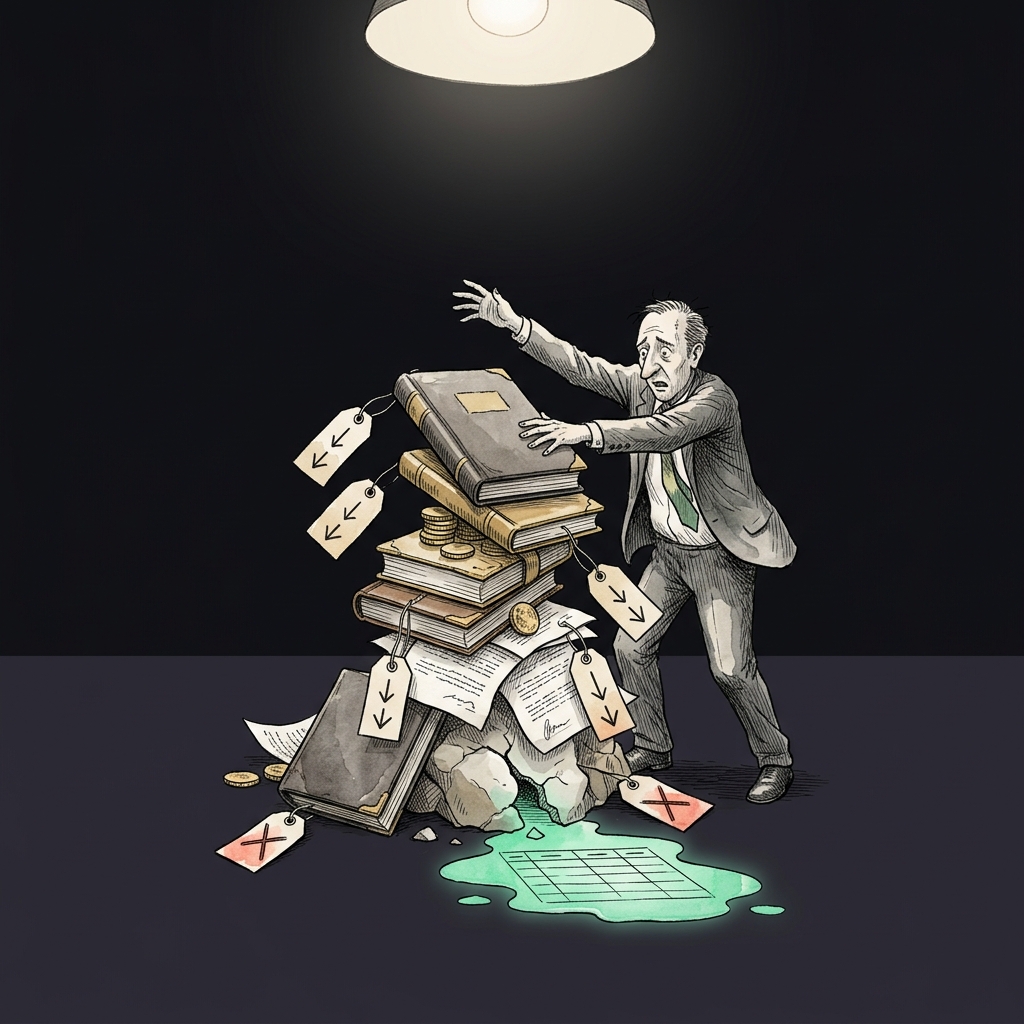
The consulting rate floor is the minimum hourly or daily fee a consultant can charge while still covering fully-loaded delivery costs — salary, overhead, non-billable time, and the buffer for unutilized hours. Charging below that floor doesn't just lose money; it signals desperation to sophisticated buyers who know professional services economics. When McKinsey, Bain, BCG, and the Big Four price their senior consultants at $300–$500 per hour blended (and partner days at £10,000+), an independent operator who quotes a $90/hour rate is telling procurement they either don't understand their own cost base or they have no other work in the pipeline. Neither read closes premium deals.
What "Below Burn Rate" Actually Means for Consultants
For a solo consultant or boutique firm, your burn rate isn't just your salary. It's the all-in cost of keeping you in front of clients: your draw, your benefits replacement (health insurance, retirement contributions, payroll tax), your business overhead (software, legal, accounting, insurance), your non-billable time (sales, marketing, admin, learning), and the structural reality that you will never sell 100% of your available hours.
The professional services industry has a name for the last variable: utilization rate. According to SPI Research's 2025 Professional Services Maturity Benchmark, the average billable utilization across professional services firms dropped to 66.4% in 2025, down from 68.9% in 2024. A healthy consulting firm targets 74–84% utilization — below that, revenue per consultant falls under break-even; above 85%, delivery quality collapses and senior staff churn.
Translation: even a fully-booked firm sells only about three of every four available hours. A solo consultant working from a home office and doing their own pipeline rarely clears 50% billable. If you priced your rate against 100% utilization, you've already capped your annual income at half of what your hourly math suggested.
Takeaway: Your rate floor is not your desired salary divided by 2,080 hours. It's your fully-loaded annual cost divided by the hours you can realistically sell — which for most independents is closer to 1,000–1,200 hours.
Why a Consulting Rate Floor Matters to Sophisticated Buyers
The buyer who hires a strategy consultant for a $200,000 engagement isn't optimizing for the lowest unit price. They're managing risk: the risk that the work won't get done, that the consultant will disappear mid-project for a higher-paying client, that the recommendations will be junior-grade because the firm couldn't afford senior talent on the account. Price below the market floor and you trigger every one of those concerns at once.
The "Underpricing Signal" research collected by Highly Persuasive frames it bluntly: in categories where quality is hard to evaluate before purchase, low price actively reduces perceived desirability. A C-suite buyer looking at three bids — McKinsey at $750K, a Tier-2 boutique at $400K, and an independent at $85K — does not conclude that the independent is the smart-money play. They conclude that the independent is either inexperienced, desperate, or doesn't understand the scope. All three are disqualifying.
This isn't theoretical. McKinsey's UK managing partner confirmed in 2025 that roughly one quarter of the firm's global fees now come from outcome-based pricing arrangements — clients arriving with a target outcome and asking the firm to price against delivering it. That kind of buyer is not looking for a discount. They're looking for a partner who can take a P&L risk alongside them, and the price tag is part of how they verify the partner has skin in the game.
Takeaway: Sophisticated buyers use price as a quality signal. When you underprice, you self-select into the pool of buyers who can only afford cheap consultants — and that pool has structurally worse projects, worse payment terms, and worse references.
The Five Cost Layers Hiding Beneath Your Rate Floor
Most independent consultants build their rate by taking their previous corporate salary, dividing by 2,000 hours, and adding a small premium. That math misses at least five cost layers:
- Salary replacement — what you used to take home as a W-2 employee, grossed up for the fact that you now pay both halves of payroll tax (15.3% in the US) plus self-employed income tax.
- Benefits replacement — health insurance, retirement, disability, and life insurance you used to get through an employer. For a family in the US, this is commonly $25,000–$40,000 per year.
- Business overhead — LLC fees, professional liability insurance, accounting, legal, CRM, productivity software, contract review, and travel. A reasonable floor is $15,000–$25,000 per year for a solo practice.
- Non-billable time — sales calls, proposal writing, marketing, networking, continuing education, internal admin. Even efficient operators spend 40–50% of their working hours here.
- The dry-spell buffer — the months between engagements when nothing is billing. If you don't price for them, your annual income is the rate-card number minus 30–40%.
Run a quick example. A consultant who wants a $180,000 take-home pays roughly $250,000 fully loaded once you add benefits, taxes, and overhead. At 50% billable utilization (1,040 hours per year), the rate floor is $240/hour — and that's just to break even on the target salary. Add a 25% reinvestment margin for growth and the floor moves to $300/hour. Anyone quoting below that is, by definition, working below their own burn rate.
Takeaway: Build your rate floor bottom-up from real numbers, not top-down from what feels comfortable to quote. The Harvest utilization calculators and the SPI benchmark data give you defensible inputs.
What Sophisticated Buyers Actually Pay (Real Benchmarks)
It helps to know the price tags your buyers are already comparing you against. Public benchmark data from 2025–2026:
- MBB blended rates — McKinsey, BCG, and Bain typically bill $300–$500 per consultant-hour blended across the team. UK day rates for these firms run £3,500–£8,000+ per consultant-day, with partner-level days exceeding £10,000.
- Big Four senior consultant rates — Per ConsultingDemand's 2025–2026 UK benchmark, Deloitte senior manager rates are roughly £1,706 per day; EY equivalents run £2,120. The mean Big Four senior-consultant day rate sits around £1,500.
- Accenture rate cards — Public framework pricing ranges from £190/day for an analyst-level "Follow" role up to £2,240/day for partner-level "Set Strategy" roles, with offshore resources priced £95–£995/day.
- Revenue per consultant — Industry average revenue per consultant is approximately $204,000 per year, with top-performing firms hitting $270,000. Big Four global functional specialists fall in the $300,000–$400,000 range per Consultancy.org's fee benchmarks.
- Pricing multiplier — The widely-used independent consulting rule (documented by Successful Independent Consulting and others) is to multiply your hourly cost by 3 to 4.5x to arrive at a defensible bill rate. The multiplier compensates for utilization gaps and overhead.
If a Fortune 500 CFO is comparing your $1,200/day quote against EY's £2,120/day, you're not undercutting the Big Four — you're confirming you don't operate at their tier. Sophisticated procurement teams read rate cards constantly; they know what each band signals.
Takeaway: Set your independent rate at 60–80% of the equivalent Big Four senior-consultant day rate in your market. That's the band where you're a credible specialist alternative, not a budget option.
Five Tactics to Hold Your Rate Floor Without Losing the Deal
The objection most consultants fear is "your rate is too high." Here's how senior operators handle it without discounting below the floor:
- Anchor with a premium option first. B2B pricing research from Pricefx and DealHub shows that buyers anchor on the first number they see. Lead with your full-scope engagement (the $250K version) before discussing the $90K diagnostic. The diagnostic now looks like the affordable entry point, not a stretch.
- Shift to value-based or outcome-based pricing. Alan Weiss's Value-Based Fees remains the canonical playbook: price against the client's economic outcome, not your hours. If your work unlocks $4M in margin, $400K is a 10% rev-share — not an expense. McKinsey is moving this direction precisely because it removes the hourly comparison entirely.
- Tier your offer with three options. Always quote three tiers: a "fast diagnostic," a "full engagement," and a "transformation partnership." Most sophisticated buyers pick the middle, which should be priced where you actually want the work to land.
- Trade scope, never rate. If a buyer pushes back, remove a workstream rather than cutting the daily rate. Dropping rate trains the market to expect that rate forever; dropping scope preserves the price signal.
- Raise rates on the next engagement, not the current one. The standard playbook is to raise rates 10–20% on every new logo until close rate drops below 50%. That's the market telling you where the ceiling is — and per the Highly Persuasive case study, raising rates from $2,000 to $3,500 often improves both client quality and total revenue while closing fewer deals.
Takeaway: Pricing is a system, not a single number. Anchor high, package in tiers, trade scope before rate, and ratchet up between engagements — that's how serious operators stay above their burn rate without losing the business.
The Bottom Line: Price Like You Intend to Stay in Business
The fastest way to lose a six-figure consulting deal is to bid it at five figures. Sophisticated buyers — the CFOs, VPs of Strategy, and PE deal teams who actually authorize external spend — read price as a quality signal first and a cost line second. They have seen too many cheap engagements fail to take a discounted bid seriously. A rate floor calculated from real fully-loaded costs (salary, benefits, overhead, realistic utilization, reinvestment) is not a marketing wish; it's the threshold below which you are losing money on every hour you work and broadcasting that fact to every buyer in your pipeline.
The discipline is straightforward: know your burn rate, compare against public benchmark rate cards, package your work in tiers, and treat the price tag as part of the product. A ready-made consulting rate card, proposal template, and engagement-economics spreadsheet model removes the temptation to wing the math in a high-pressure sales call — which is when discounting damage usually happens. Building that template once, with real cost inputs, is the single highest-leverage thing an independent consultant or boutique principal can do this quarter.
Sources
- TheStreet — AI is forcing McKinsey, BCG, Bain to rethink consulting fees, 2025
- Saibon Group — Consultant Utilization Rate Benchmarks 2025–2026 (citing SPI Research)
- ConsultingDemand — UK Consulting Day Rates in 2025–2026: The Definitive Benchmark Guide
- Slideworks — Management Consulting Fees: How McKinsey Prices Projects, 2026
- Consultancy.org — Consultancy Fees & Rates Benchmarks
- Highly Persuasive — When Your Price Is Too Low: The Underpricing Signal
- Successful Independent Consulting — How to Figure Out Your Consulting Bill Rate
- Alan Weiss — Value-Based Fees: How to Charge What You're Worth (3rd Edition)
Related: Browse all Consulting Templates on ModelStack.
Get started with a free template
Download our free Unit Economics Calculator — no signup required.