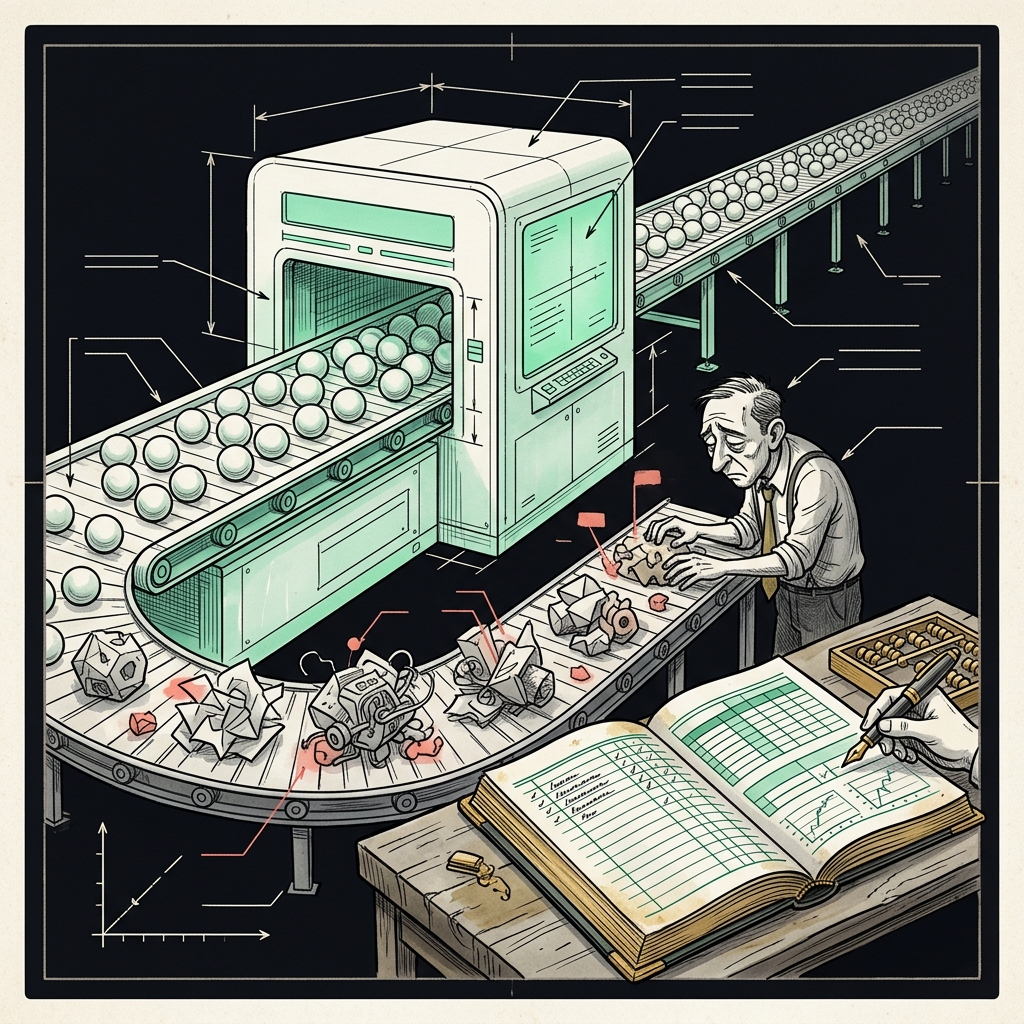
AP invoice exception handling is the process of investigating and resolving the subset of supplier invoices that fail automated checks — typically PO mismatches, missing data, duplicate flags, vendor master discrepancies, and tolerance breaks. Even at world-class AP shops, 9-22% of invoices land in the exception queue, and that minority consumes the majority of clerk time, vendor escalations, and late-payment risk. The paradox of automation is that as straight-through processing rises, the work that remains gets harder, not easier.
Why Automation Concentrates the Pain Instead of Eliminating It
The math is unforgiving. According to Ardent Partners' AP Metrics That Matter in 2025 (published with Pagero), top-performing AP teams hit a 9% exception rate while the broader industry sits at 22%. That sounds like progress — and it is — but it changes the shape of an AP clerk's day. When 91 of every 100 invoices flow through untouched, the remaining 9 are the gnarly ones: foreign-currency suppliers with shifting tax IDs, three-way matches blocked on a 0.7% price variance, freight surcharges that never appeared on the PO, or a duplicate flag triggered by a vendor who reissued an invoice with a new number.
Spend Matters' 2026 analysis of invoice processing maturity puts it plainly: as touchless rates climb past 70%, the cost-per-exception climbs with them, because the easy stuff is gone and what remains requires judgment, supplier dialogue, and cross-system reconciliation. APQC's benchmarking data backs this up — best-in-class organizations process invoices for roughly $2.78 each on average, but the marginal cost of a single exception can run 10-20× that once you factor in clerk time, approver escalation, and the carrying cost of late payment.
Takeaway: Don't measure success solely by touchless rate. Track cost-per-exception and exception-clearance time as first-class KPIs.
The Five Exception Categories That Account for 80% of the Queue
If you sample 1,000 exceptions across a mid-market AP shop, the distribution is remarkably consistent. The Stampli blog on invoice processing errors and Ramp's invoice discrepancy guide both converge on the same taxonomy. Here is the breakdown that survives across SAP, Oracle, NetSuite, and dedicated AP platforms like AvidXchange and Tipalti:
- Price variance (PO mismatch). The invoice price exceeds the PO price beyond tolerance. Root cause is almost always a contract amendment that procurement negotiated but never reflected in the open PO. In SAP, this triggers the PP tolerance key in OMR6.
- Quantity variance. Invoiced quantity exceeds received quantity. Either the goods receipt is missing, the receiving team posted to the wrong PO line, or the supplier over-shipped.
- Missing PO reference. A non-PO invoice arrives for what should have been a PO purchase. Common in services, marketing spend, and shadow procurement.
- Duplicate invoice flag. The same supplier, amount, and date pattern appears twice — sometimes because the supplier resent it, sometimes because the same invoice came in via email and the supplier portal.
- Vendor master mismatch. The remit-to bank account, tax ID, or legal entity name on the invoice doesn't match the vendor master. This is also where fraud risk lives.
Tax errors, FX rounding, and missing supporting documents (timesheets, packing slips, contracts) round out the remaining 20% of the queue.
Takeaway: Code every exception against this five-bucket taxonomy at intake. You cannot fix root causes you do not measure.
The Tolerance Trap: Why Setting Thresholds Too Tight Doubles Your Workload
Every AP automation platform — SAP MM, Oracle Payables, Coupa, Stampli, AvidXchange — exposes tolerance settings for the three-way match. The SAP community guidance on OMR6 is explicit: tolerances that are too tight create excessive manual reviews, while tolerances that are too loose hide real financial leakage. Oracle's documentation recommends defining both percentage-based and absolute-value tolerances, e.g., "2% price variance OR $50 absolute, whichever is lower."
Here is the framework I use on every AP redesign:
- Price tolerance (PP key in SAP): 2-5% AND a $25-$100 absolute floor. Below the floor, no human looks at it.
- Quantity tolerance (DQ key): 0% upper, 10% lower (over-receipt is fraud-adjacent; under-receipt is normal).
- Small differences (BD key): $10 absolute, no percentage. Auto-post the variance to a tolerance G/L account.
- Review cadence: Quarterly. Pull the last 90 days of exceptions, look at the variance distribution, and tighten or loosen by category.
The most common failure mode I see is a finance team that sets tolerances at 0% to "stay in control" and then drowns in 18% exception rates. Every dollar variance that flows through a $25 absolute floor saves roughly $15-$30 in fully-loaded clerk time, per APQC benchmarks. The math favors looser tolerances on small variances and tighter tolerances on large ones — exactly the opposite of how most teams set them.
Takeaway: If your tolerance G/L account never accrues variance, your tolerances are too tight. Calibrate quarterly with a real variance distribution, not a gut feel.
Building an Exception Workflow That Doesn't Collapse Under Volume
The platforms — Stampli, AvidXchange, Tipalti, Medius, Basware — each have their own exception UX, but the underlying workflow is the same. A step-by-step exception process that scales looks like this:
- Classify at intake. The OCR/IDP layer (whether it's Stampli's AI, AvidXchange's capture, or a Hypatos-style specialist extractor) tags the exception type before it hits a human queue.
- Route by category, not by amount. Price mismatches go to the buyer. Missing GR goes to receiving. Vendor master issues go to vendor maintenance. Most AP shops route everything to the AP clerk by default — that's wrong. The clerk becomes a switchboard instead of a closer.
- Set an SLA per category. Duplicate checks: 24 hours. Price mismatches under $1,000: 48 hours. Vendor master changes: 5 business days (because they require dual approval to prevent fraud).
- Auto-escalate on age. If an exception sits unworked for 2× SLA, escalate to the category owner's manager. Most platforms do this natively; if yours doesn't, build it.
- Close the loop with a root-cause code. Every cleared exception gets a code: "PO amendment missing," "supplier sent duplicate," "receiver posted wrong line," etc. This data is gold for the prevention work in the next section.
Stampli's comparison content notes that touchless rates are ultimately decided at the document-extraction layer, not the workflow layer. If your OCR misclassifies 30% of invoices at intake, no amount of workflow elegance will save you. Spend on the front of the pipeline first.
Takeaway: Route exceptions by category to the person who can actually resolve them. The AP clerk should be the exception manager, not the exception worker.
Preventing Exceptions Before They Hit the Queue
The cheapest exception is the one that never happens. The Rillion blog on exception management and the Medius work on AP accuracy both make the same point: 60-70% of recurring exceptions trace to fewer than 50 root causes, most of them upstream of AP. Here is the prevention playbook:
- Vendor master hygiene. Run a quarterly cleanup against the IRS TIN database for US suppliers and equivalent registries elsewhere. Stale remit-to data is the #1 cause of vendor master exceptions and the #1 entry point for invoice fraud.
- PO discipline. Mandate POs above a threshold (e.g., $2,500) and enforce it in the requisition system. Every non-PO invoice is a manual exception by definition.
- Contract-to-PO synchronization. When procurement renegotiates pricing, the PO must be updated the same day. Most price variance exceptions are this gap, not supplier error.
- Supplier onboarding standards. Require the PO number on every invoice as a condition of payment terms. Tipalti and AvidXchange both surface this in supplier portals; even a static "please include PO# on all invoices" line in your remit-to instructions reduces missing-PO exceptions materially.
- Top-10 supplier review. Look at the top 10 suppliers by exception volume every month. One bad supplier (or one bad buyer mapping to that supplier) often generates 20-30% of your exception queue.
Ardent Partners' research highlights that top-performing AP organizations differentiate themselves not by better workflow tools but by tighter upstream controls. The exception rate gap between 9% (top quartile) and 22% (average) is mostly explained by procurement and vendor master discipline, not by AP software choice.
Takeaway: Treat your top recurring exceptions as a prevention backlog, not a queue to clear. Every root cause you eliminate compounds.
The Operating Metrics Your AP Function Should Be Tracking
If you walked into a CFO review tomorrow, these are the numbers to bring — and the APQC and Ardent benchmarks to measure them against:
- Touchless processing rate: Target 70-80%. Best-in-class hits 80%+.
- Exception rate: Target sub-15%. Top performers run 9%.
- Cost per invoice: APQC top quartile is around $2.78; median around $10.18. If you're above $15, automation has clear ROI.
- Invoice cycle time: Ardent Partners benchmarks best-in-class at 3.1 days; the rest at 17.4 days.
- Exception clearance time by category: Track median and 90th percentile. The 90th percentile is where the supplier complaints come from.
- Early payment discount capture rate: If you're capturing less than 80% of available discounts, exceptions are eating your float.
- Duplicate payment recovery rate: Should trend toward zero as exception handling matures. Anything above 0.05% of total spend is a control gap.
Takeaway: If you can't produce these seven numbers in under 10 minutes, your AP function is flying blind. Build the dashboard first; redesign the process second.
Putting It All Together
The shift from "AP clerk processes invoices" to "AP clerk manages an exception portfolio" is the single biggest operating-model change in finance over the past five years. Automation doesn't reduce the importance of AP — it concentrates it. The 20% of invoices that still need a human are the ones where vendor relationships, fraud risk, working capital, and audit trails all collide. A well-designed exception workflow, calibrated tolerances, a clean root-cause taxonomy, and a prevention backlog turn that 20% from a liability into a controllable cost center.
Most teams don't fail on strategy — they fail on the artifacts. They don't have a standardized exception coding sheet, a tolerance-calibration worksheet, a vendor-master cleanup checklist, or a monthly exception dashboard. That's where a ready-made AP exception handling template kit changes the equation: instead of building the Excel model, the workflow SOP, and the tolerance framework from scratch, you start from a battle-tested example and tune it to your ERP. The two weeks you save building artifacts is two weeks you spend actually reducing the exception queue.
Sources
- Ardent Partners, AP Metrics That Matter in 2025 (with Pagero)
- Ardent Partners, AP Metrics That Matter in 2025 overview, 2025
- APQC, Understanding Accounts Payable Benchmarks and Best Practices
- Spend Matters, Invoice processing maturity: From automation rates to exception economics, March 2026
- Stampli, How to solve the most common invoice processing errors
- Ramp, Invoice Discrepancies: Types, Causes & How to Resolve Them
- Rillion, AP Invoice Exception Management – How to Reduce Exception Rates
- SAP Community, SAP Three-way Match Functionality & Configuration
- Oracle Payables Help, Invoice Tolerances
- Medius, Benchmarking AP Accuracy and Understanding Acceptable Invoice Error Rates
Related: Browse all AI Workflow Templates on ModelStack.
Get started with a free template
Download our free Unit Economics Calculator — no signup required.