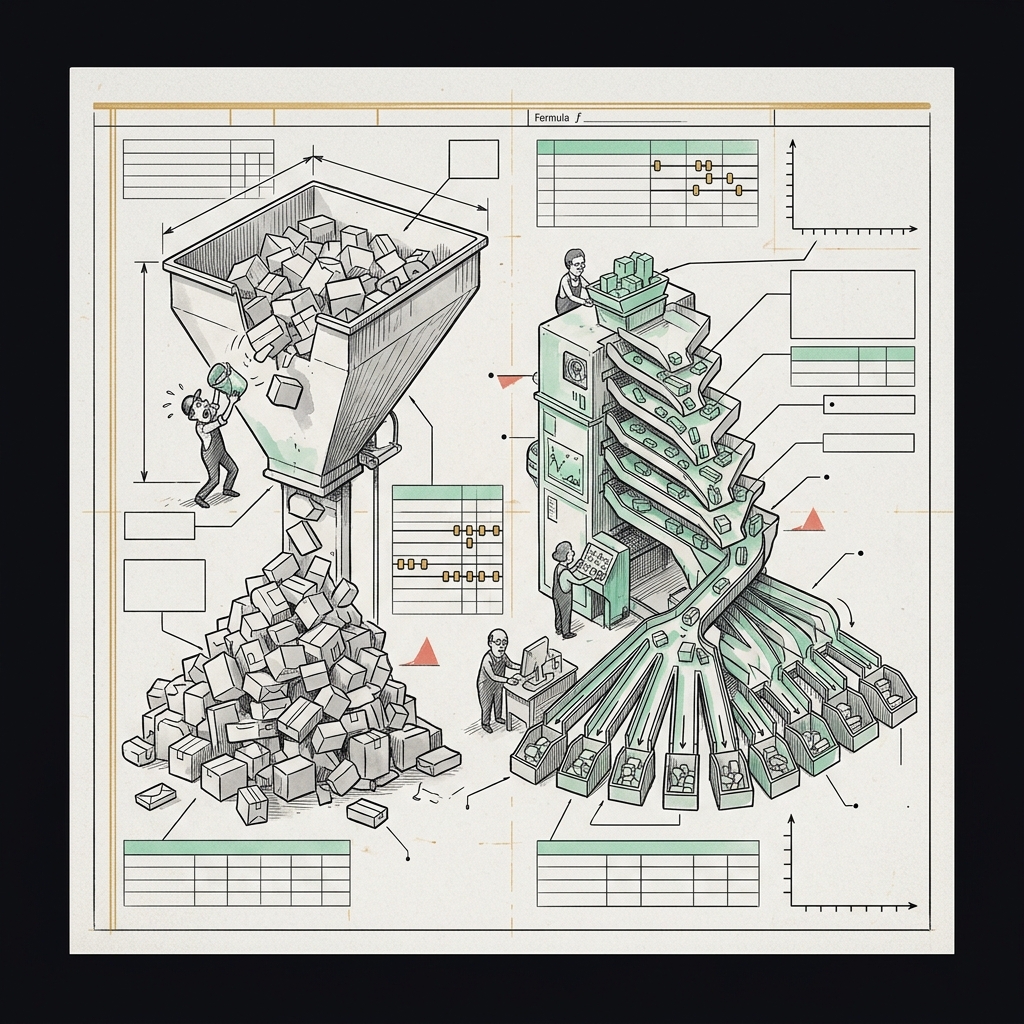
AI customer service intent classification is the process of using machine learning models to read an incoming support ticket, chat, or email and automatically tag it with the specific reason the customer contacted you. The narrower and more specific the intent labels, the faster tickets reach the right agent or automated resolution path. Broad buckets like "billing" or "account" force a second layer of human triage that adds hours to resolution time and drops routing accuracy from the 90%+ range down toward 78% or worse.
This guide breaks down why category width is the single biggest lever in your triage stack, how the leading platforms (Zendesk, Intercom Fin, Salesforce Einstein) structure their taxonomies, what Klarna's rollout of 2.3 million AI-handled conversations actually taught the industry, and a step by step framework for redesigning your own intent tree.
Why AI Customer Service Intent Classification Beats Rule-Based Routing
Traditional rules-based routing — keyword matching, form-field dropdowns, sender-domain logic — tops out at roughly 40–50% accuracy according to industry surveys aggregated by Unthread's 2026 AI support accuracy report. AI intent classification, which reads the semantic meaning of the ticket rather than matching strings, hits 85%+ intent recognition accuracy at a reasonable benchmark, with leading deployments (Twig, Intercom Fin, Zendesk Advanced AI) reaching 90–95%.
The mechanism is straightforward. A customer writes "my card got charged twice for order #4451 and I want one refunded." A keyword rule sees "refund" and drops the ticket in a general refunds queue. An intent classifier tags it as duplicate_charge_refund_request, which routes to the payments sub-team with the order number pre-extracted and a suggested reply template already loaded. The first path takes an agent seven minutes of context-gathering; the second takes forty seconds of confirmation.
Takeaway: If your routing is still form-field or keyword driven, switching to an intent model is worth 30–50 accuracy points before you touch anything else. That is the easy win. The hard win — and the topic of the rest of this piece — is designing the intent taxonomy itself.
The Category Width Problem: Why Broad Intents Route Slower
Here is the counter-intuitive result that catches most support ops leaders off guard. Supportbench's routing QA data shows that teams running fewer than 20 broad categories achieve about 92% routing accuracy, while teams that let their taxonomy sprawl past 20 unstructured categories drop to around 78%. The reflex response is "so keep categories broad." That is the wrong lesson.
The correct lesson is that flat, broad categories and flat, unstructured many-category taxonomies both fail — for opposite reasons. Broad categories fail because they force a second human triage step; sprawling flat lists fail because the model cannot distinguish semantically similar intents without hierarchy.
Zendesk's public documentation on intelligent triage explicitly recommends a three-level hierarchy — category, subcategory, intent — and states that a mature deployment sits at 60 to 80 intents. Not 8. Not 200. Sixty to eighty specific intents, grouped under a small number of categories, with subcategories bridging the two.
Consider the difference in routing latency:
- Broad only ("Billing"): Ticket lands in Billing queue → tier-1 agent reads it → reassigns to Disputes → dispute specialist opens it → asks for order number → resolves. Average: 4–6 hours end to end.
- Hierarchical ("Billing → Disputes → duplicate_charge"): Ticket lands directly with dispute specialist, order number auto-extracted, suggested resolution template pre-loaded. Average: 15–40 minutes.
Multiply that gap by 3,000 tickets per month and the labor arbitrage becomes obvious. Supportbench's aggregated numbers put the cost of manual re-routing at roughly $260,000 per year for a mid-sized SaaS support org running at 23% misroute rate.
Takeaway: The right question is not "how many categories" but "how deep is the tree." Aim for 3 levels: 6–10 top categories, 3–5 subcategories each, 60–80 leaf intents total.
What Klarna's 2.3 Million Conversation Rollout Proved
Klarna's February 2024 press release announced that its OpenAI-powered assistant handled 2.3 million conversations in its first month, equivalent to 700 full-time agents, resolved issues in under 2 minutes (down from 11), and drove a projected $40 million profit improvement for 2024. The headline was AI replacing humans. The operational lesson was quieter and more important: Klarna won by scoping the AI to narrow, specific intents from day one.
Per CX Today's follow-up coverage and Forbes' July 2026 retrospective on the Klarna rollout, the assistant was deployed against a bounded intent list — refunds, order tracking, simple disputes, FAQ lookups — and explicitly not asked to handle account closures, regulated inquiries, or escalated complaints. When ambiguity or regulated topics were detected, the AI routed to a human. That escalation gate itself is an intent classification decision: "this ticket's intent is one my model has low confidence on" is a routing signal.
The follow-up story is instructive too. Klarna publicly walked back parts of the rollout in 2024–2025, rehiring human agents for exactly the intent classes the model had originally been kept away from. The takeaway is not that AI failed; it is that the intent boundary was the correct place to draw the line, and pushing the AI past it degraded quality. Forbes' Bernard Marr framed it as: "the intent scoping was right; the marketing was wrong."
Takeaway: Build your intent list as two columns from day one — "AI resolves" and "AI classifies and escalates." Never as one big list where confidence thresholds silently determine which is which.
The Long-Tail Problem and Why Narrow Intents Solve It
Every support queue follows a power law. A handful of intents (password reset, order status, refund request) make up 60–70% of volume. Behind them sits a long tail of hundreds of low-frequency intents that individually look trivial but collectively drive 30–40% of tickets and a disproportionate share of escalations. Aide's glossary and Channel's production-data analysis both describe this shape explicitly.
A broad-category taxonomy actively hides the long tail. If your top category is "Account Issues" and it contains 47 distinct underlying intents ranging from "cannot log in on iOS Safari" to "need to change legal name on tax documents," you have no signal that the iOS Safari login problem is spiking after an app release, and no way to route the tax-name change to the compliance team that must handle it. The long tail collapses into a mush that the routing model cannot distinguish and that your analytics dashboard cannot surface.
Narrow intents fix both problems at once:
- Routing precision: Each leaf intent maps to exactly one team, one macro, and one SLA tier. No second triage step.
- Signal for product and engineering: A spike in a specific leaf intent (say, ios_safari_login_failure) becomes a Jira ticket, not a vague uptick in "Account Issues" volume.
- Model training data quality: The classifier learns crisp examples per intent rather than trying to separate 47 semantically-different requests all labeled "Account Issues."
- Automation surface area: Intercom's public Fin benchmarks show resolution rates varying from 25% to over 80% across customers, with the delta driven almost entirely by knowledge base structure. Narrow intents let you map each leaf to a specific KB article, which is what pushes Fin from 45% to 67%+ resolution.
Takeaway: The long tail is where your differentiation and your pain both live. Broad categories bury it. Narrow intents surface it.
A Step by Step Framework for Redesigning Your Intent Taxonomy
Whether you are on Zendesk Intelligent Triage, Salesforce Einstein Case Classification, Intercom Fin, or a homegrown model, the process is the same. Budget two weeks of a senior operator's time, plus a spreadsheet model for intent volume and routing rules.
- Export 90 days of tickets. Aim for at least 5,000 tickets, ideally 20,000+. Anything less and the long tail is invisible in the sample.
- Cluster with an LLM, not by hand. Feed the ticket subjects and first-message bodies to a model (Claude, GPT-4o, Gemini) with a prompt asking for 60–80 distinct intent clusters. Do not accept fewer than 40. This is the step where operators most commonly fail — they cluster to their existing categories and re-create the flat taxonomy they already had.
- Score each intent on four dimensions: monthly volume, average handle time, escalation rate, and automation potential (can a KB article + workflow resolve this end to end?).
- Group leaf intents into subcategories, then subcategories into categories. Cap at 3 levels. Follow Zendesk's public recommendation: 60–80 leaves, roughly 15–25 subcategories, 6–10 top categories.
- Assign each leaf intent a routing rule. One team, one macro, one SLA tier. Two of the columns should be "AI resolves fully" and "AI classifies, human resolves" — the Klarna split.
- Backtest against last quarter's tickets. Have the model classify each historical ticket against the new taxonomy. Compare predicted routing against actual routing. You are looking for two things: intents where predicted routing beats actual (the wins) and intents where the model has <80% confidence (which need more training data or should be merged).
- Roll out in shadow mode for two weeks. Let the classifier predict but not route. Measure precision, recall, and confidence distribution per intent. Fix the worst-performing 10% before going live.
- Instrument the escalation gate. Every ticket the AI routes to a human is a labeled data point. Feed those labels back weekly. The taxonomy is a living document, not a launch artifact.
Salesforce's public documentation on Einstein Case Classification is explicit that the model needs at least 400 closed cases per intent to reach production accuracy. If a leaf intent does not clear that bar within a quarter, merge it up one level or accept that it will run in "AI classifies, human resolves" mode indefinitely. That is fine — a correctly-classified ticket routed to a human is still faster than an unclassified ticket routed to a triage queue.
Takeaway: The taxonomy redesign is not a one-time project. Ship the first version in 2 weeks, review it monthly, and expect the leaf-intent count to grow from 40 to 60 to 80 over the first year as Zendesk's own rollout playbook describes.
What Broad Categories Are Actually Costing You
Run the math on your own queue. Take your monthly ticket volume, multiply by the 23% average misroute rate from Supportbench's SaaS benchmarks, and multiply that by the 4.2 hours of added resolution time per misroute. For a support org handling 3,000 tickets a month, that is roughly 2,900 agent-hours per year of pure triage-and-reassign labor — before you count the CSAT hit from customers who wait longer for the wrong team's initial response.
Now run the same math against Klarna's post-migration numbers: resolution time dropped from 11 minutes to under 2, and repeat inquiries dropped 25%. The delta is not the AI itself — it is what the narrow-intent scoping made the AI capable of doing without a human in the loop. Intercom's public data on Fin's 25%-to-80%+ resolution range across its customer base tells the same story: the ceiling on your AI's performance is set by how cleanly your intents map to your knowledge base, not by which vendor you buy.
Redesigning your intent taxonomy is a spreadsheet exercise plus two weeks of clustering work. It is one of the highest-ROI projects available to a support ops leader in 2026, and it does not require a platform migration, a headcount change, or an AI vendor decision — it requires deciding that "Billing" is not an intent, that duplicate_charge_refund_request is, and that the difference between the two is measured in hours per ticket and hundreds of thousands of dollars per year.
If you are building this from scratch, a ready-made intent taxonomy template, routing matrix, and SLA scoring model can save you the 40-plus hours of spreadsheet work involved in getting the first version shippable. The frameworks in ModelStack's SOP and AI Workflow templates are built exactly for this — pre-structured category/subcategory/intent trees, volume scoring rubrics, escalation gate designs, and backtest worksheets — so your team spends its time on the domain judgment (which intents belong under which category for your business) rather than on rebuilding the scaffolding.
Sources
- Klarna press release: AI assistant handles two-thirds of customer service chats in its first month
- Forbes / Bernard Marr, How Klarna's AI Agent Strategy Backfired But Became A Useful Lesson, July 2026
- CX Today, Klarna's AI Customer Service Roadmap: Why Human Support Still Matters
- Zendesk Help Center, Intents Explained (Ultimate)
- Zendesk Help Center, Automatically classifying customer intent, sentiment, and language
- Intercom Fin, AI customer support benchmarks
- Intercom, Fin 3 Reaches 67% Average Resolution Rate, 2025
- Unthread, AI Support Accuracy Stats 2026: CSAT, Deflection & ROI
- Supportbench, Ticket Routing QA Checklist: Reduce Misroutes
- Aide Glossary, What are Long-Tail Intents?
Related: Browse all AI Workflow Templates on ModelStack.
Get started with a free template
Download our free Unit Economics Calculator — no signup required.