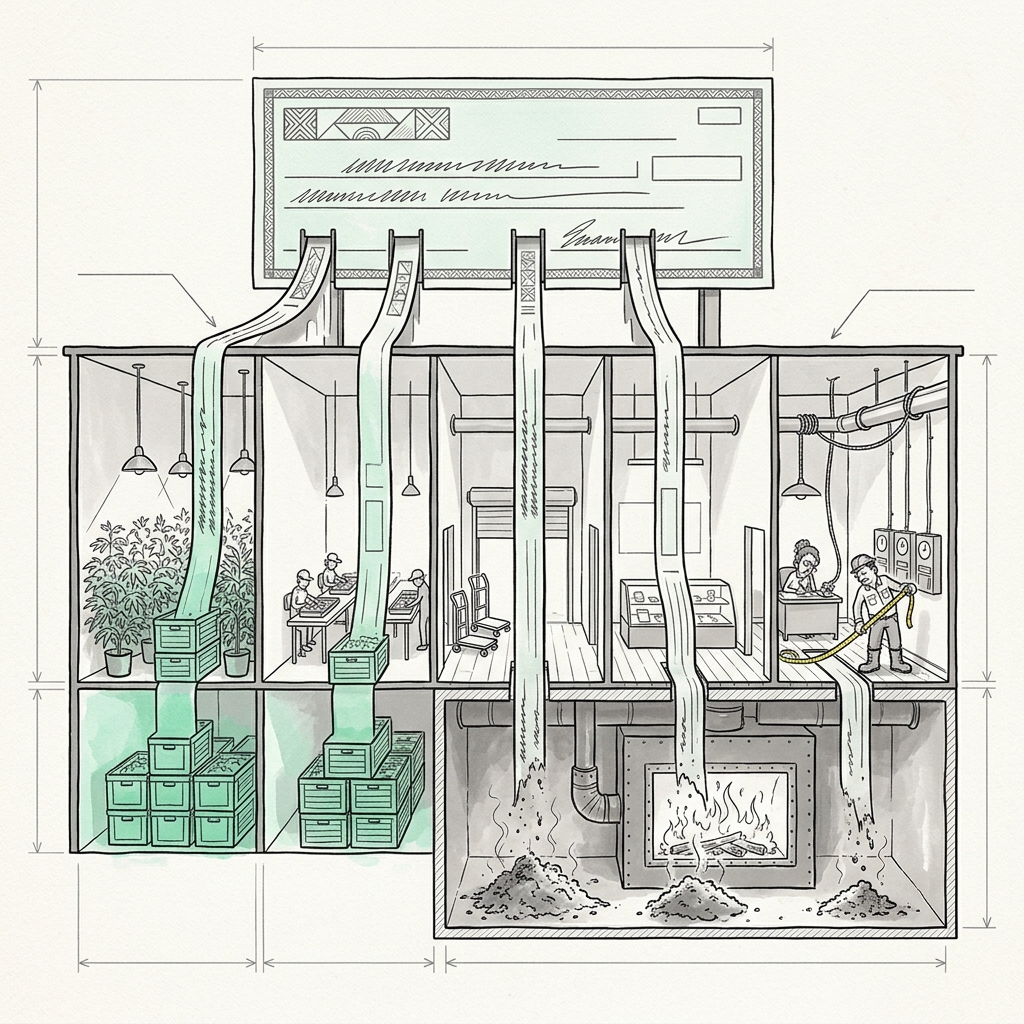
Rent is the cleanest example of the 280E problem. A cannabis company pays one landlord one check for one building. Inside that building, part of the floor grows plants, part trims and packages them, part sells them, and a corner holds the office. For federal tax, those square feet are not equal. The grow room's share of rent can be a production cost that goes into inventory. The sales floor's share, for a business subject to 280E, is a cost the business cannot deduct at all.
Allocation is how one check becomes several numbers. This piece walks through a full allocation, line by line, using the illustrative sample company built into our worksheet, so you can see how the method works and where it breaks. The numbers are made up for the example. The method is the point. It is educational, not tax advice.
If the difference between inventoriable costs and non-deductible costs is new to you, read 280E cost accounting basics first.
Step 1: name the functions
Start with the parts of the business that do different things. For a vertically integrated operator, five is a sensible minimum:
- Cultivation: growing the plant.
- Processing: drying, curing, trimming, extraction, packaging into saleable units.
- Distribution: moving product and selling it wholesale.
- Retail: selling to customers.
- G&A: management, accounting, legal, marketing, the office.
Then decide, with your CPA, which of these you treat as production. A common starting point treats cultivation and processing as production and the other three as not. Distribution is the one people argue about, and it is exactly the kind of decision you should write down with your reasoning, because someone may ask about it in three years.
Step 2: choose a driver for each kind of cost
A driver is the measure you use to split a shared cost. The rule of thumb: pick the measure that best reflects what causes the cost.
| Driver | Good for | Sample company |
|---|---|---|
| Square feet | Rent, security, repairs, building utilities | Cultivation 12,000; processing 3,000; distribution 1,500; retail 2,500; G&A 1,000 |
| Labor hours | Supervisors and managers who work across functions | Cultivation 21,000; processing 8,000; distribution 4,000; retail 9,000; G&A 6,000 |
| Headcount | Benefits, payroll taxes, HR software, insurance tied to staff | 14, 5, 3, 7, 4 |
| Electricity share | Power, and equipment that draws it | From sub-meters or an engineer's load estimate: cultivation 78%, the rest small |
| Direct | Costs that belong wholly to one function | Cultivation wages, nutrients, packaging, retail wages |
Square feet are the easiest to defend because anyone can measure a floor plan. Electricity is the most important for an indoor grow, and the hardest to support without sub-meters. Labor hours are only as good as your timekeeping.
Step 3: allocate, line by line
Here are four lines from the sample company's cost pool, worked through.
Rent: $420,000, by square feet
Total floor is 20,000 square feet. Cultivation's 12,000 is 60%, so cultivation carries $252,000. Processing's 3,000 is 15%, or $63,000. Distribution gets 7.5% ($31,500), retail 12.5% ($52,500), G&A 5% ($21,000). With cultivation and processing treated as production, $315,000 of rent goes into inventory and $105,000 does not.
Management salaries: $380,000, by labor hours
Cultivation logs 21,000 of 48,000 total hours, or 43.75%, so $166,250 of management salary follows the grow. This line is where weak records cost the most. If you cannot show how your managers spend their time, a reviewer may push back on spreading their pay across functions at all.
Payroll taxes and benefits: $210,000, by headcount
Fourteen of 33 people work in cultivation, so cultivation carries about $89,091. Headcount is crude, since a part-timer counts the same as a full-timer, but it is simple and consistent. If your staff mix is lopsided, allocate payroll taxes in proportion to the wages you have already allocated instead.
Accounting and legal: $95,000, direct to G&A
No allocation. It is general and administrative, it does not touch production, and for a business under 280E it is not deductible.
Step 4: read the result
Run every line of the sample company's $3,652,000 cost pool through the same method and you get this split:
| Amount | Share | |
|---|---|---|
| Inventoriable production costs | $2,504,318 | 69% |
| Non-deductible under 280E | $1,147,682 | 31% |
At the 21% federal corporate rate, the worksheet shows the disallowed amount costs this sample company about $241,000 in federal tax that a business outside 280E would not pay. That figure is an illustration of scale, not a tax calculation: real returns involve state taxes, timing, inventory changes and a dozen other things.
Where allocations go wrong
- One driver for everything. Spreading every shared cost by square feet is simple and usually wrong, because power and people do not follow floor area.
- Changing the method every year. A method that moves whenever the answer changes is hard to defend. Pick it, document it, keep it.
- No support for the drivers. Floor plans, meter readings and time records should sit in the same folder as the workbook.
- Allocations that do not tie. If the allocated pieces of a line do not add back to the line, money has leaked somewhere. Every line should tie out to the cent.
- Forgetting the regime changed. Since the April 2026 order moving state-licensed medical marijuana to Schedule III, some operators may have activity in and out of 280E in the same year. See what changes on the books.
What AI can and cannot do in this process
The allocation is arithmetic once the decisions are made. AI is useful before and after the arithmetic: coding raw transactions to the right cost line, keeping drivers current from payroll and time-clock exports, flagging lines whose allocation changed sharply from last year, and drafting the narrative of the method for your CPA's file. What it cannot do is choose the drivers for you in a way that holds up, decide that distribution is production, or produce support you do not have. The decisions in steps 1 and 2 are judgment, and they should carry a person's name.
Tools for the work
Everything above, including the sample company, is built into the 280E Cost Allocation Worksheet ($79): a drivers tab, a treatment tab where you record which functions are production and why, a cost pool of up to 40 lines each with its own driver, a tie-out check on every line, a 280E on/off switch, and a summary. Replace the sample numbers with yours and the whole thing recalculates.
If you would rather the coding and driver updates ran automatically each month, Agor AI builds back-office automations for small finance teams. Start with the $250 AI Automation Audit, credited toward a build.
This is part of a weekly series on AI for finance and back-office work. Get it by email.
This article is educational and is not tax, legal or accounting advice. The sample figures are illustrative. Which costs are inventoriable depends on your facts and your inventory method; confirm your approach with a CPA who works with cannabis businesses.
Sources
- 26 U.S. Code 280E (Cornell LII)
- 26 CFR 1.471-11, Inventories of manufacturers (Cornell LII)
- 26 CFR 1.471-3, Inventories at cost (Cornell LII)
- 26 U.S. Code 11, Tax imposed (corporate rate) (Cornell LII)
- Patients Mutual Assistance Collective Corp. v. Commissioner, 151 T.C. 176 (2018), aff'd, 995 F.3d 671 (9th Cir. 2021)
- Saul Ewing: DEA Reschedules FDA-Approved Marijuana Products and State-Licensed Medical Marijuana to Schedule III (April 23, 2026)