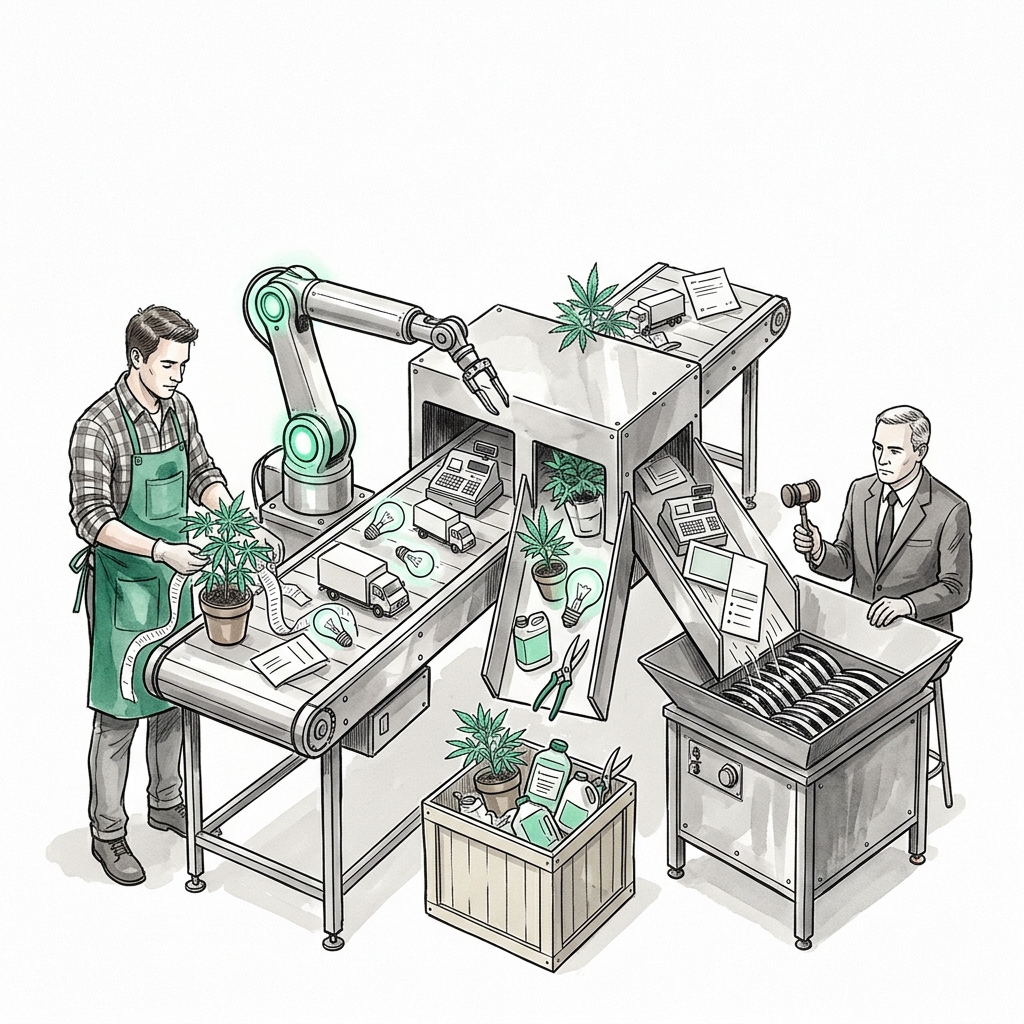
Section 280E of the Internal Revenue Code is one sentence long. It says no deduction or credit is allowed for any amount paid or incurred in carrying on a trade or business that "consists of trafficking in controlled substances (within the meaning of schedule I and II of the Controlled Substances Act) which is prohibited by Federal law or the law of any State in which such trade or business is conducted." That sentence, written in 1982 with drug dealers in mind, is why a licensed, tax-paying cannabis business can owe federal income tax on money it never made.
This piece covers the accounting that follows from that sentence: what 280E takes away, what it leaves alone, the court cases that drew the lines, and where software, including AI, actually helps. It is the first piece in a series on cannabis finance. It is educational, not tax advice.
What 280E takes away, and what it cannot touch
280E disallows deductions. It does not disallow cost of goods sold, because cost of goods sold is not a deduction. It is subtracted from gross receipts to get gross income in the first place. Courts and the IRS have treated that distinction as settled for years, and it is the whole game. Every dollar that can properly sit in inventory, and come out as cost of goods sold when the product is sold, reduces taxable income. Every dollar that cannot is, for a business subject to 280E, simply gone.
So a 280E business has two piles of cost:
- Inventoriable costs. The costs of producing or acquiring the product, capitalized into inventory and recovered through cost of goods sold.
- Everything else. Rent on the sales floor, budtender wages, marketing, the accountant, the lawyer, the software. Ordinary business expenses that any other company would deduct, and that a 280E business cannot.
The practical question for the books is never "is this a real expense." It always is. The question is which pile it belongs in, and whether you can prove it.
Which inventory rules apply: producer or reseller
Inventory costing comes from section 471 of the Code and the regulations under it. The rules differ by what you do.
| Activity | Rule | What can go into inventory |
|---|---|---|
| Producer (cultivation, manufacturing, extraction) | Treas. Reg. 1.471-11, full absorption | Direct materials, direct labor, and indirect production costs such as production-floor rent, utilities, repairs and supervision tied to production |
| Reseller (a dispensary buying finished product) | Treas. Reg. 1.471-3(b) | The invoice price, less discounts, plus transportation and other necessary charges to acquire the goods |
A cultivator therefore has far more room than a retailer. Grow-room power, the cultivation crew, nutrients, the share of rent that covers the canopy: all of that is production cost. A dispensary that buys finished goods gets the invoice and the freight, and not much else.
Vertically integrated operators have both, and they have to keep them apart. The cultivation side can absorb indirect production costs. The retail side cannot. If one general ledger blends them, the return will either leave money on the table or claim more than the rules allow, and an examiner will not be the one who untangles it for you.
The cases that drew the lines
Three Tax Court decisions do most of the work in practice.
Californians Helping to Alleviate Medical Problems (CHAMP) v. Commissioner, 128 T.C. 173 (2007). The court allowed deductions for a caregiving business that was a genuinely separate trade or business from the dispensing, with its own activities. This is where the "separate trade or business" idea comes from.
Olive v. Commissioner, 139 T.C. 19 (2012), affirmed by the Ninth Circuit in 2015. A dispensary that offered free services alongside sales argued the services were a separate business. The court disagreed: the free services did not earn their own income, so the whole thing was one trafficking business, and 280E reached all of it. The lesson is blunt. A separate business needs to be a real business, not a relabeled cost center.
Patients Mutual Assistance Collective Corp. (Harborside) v. Commissioner, 151 T.C. 176 (2018), affirmed by the Ninth Circuit in 2021. Harborside, a large Oakland dispensary, argued it could use section 263A, the broader uniform capitalization rules, to pull more of its costs into inventory. The court held that a reseller subject to 280E is limited to what section 471 and its regulations allow for resellers. It also upheld 280E against the argument that it should not apply to a state-legal business.
Put the three together and you get the working rules most cannabis CPAs follow: cost of goods sold is safe ground, the producer and reseller rules are strict, and separate-business arguments only hold when the business is truly separate.
What this means for your chart of accounts
None of this is won at tax time. It is won, or lost, in how the books are kept all year. The pieces that matter:
- Cost centers by function. Cultivation, processing, distribution, retail, and general and administrative, at minimum. Every expense lands in one, or is allocated across several.
- An allocation method, written down. Shared costs such as rent, power, insurance and management salaries need a driver: square feet, labor hours, headcount, metered electricity. Pick drivers that reflect how the cost is really used, and use the same ones every year.
- Time records for people who split roles. A manager who spends mornings in the grow and afternoons on payroll is part production cost and part not. Without time records, the whole salary tends to land on the wrong side.
- Inventory that ties out. Your inventory records, your state track-and-trace system and your general ledger should agree, or you should know why they do not.
If you take one opinion from someone who ran the books at a cultivator: settle the method before the year starts, not in March when the return is due. A method chosen after you know the answer looks exactly like what it is.
What AI can do here
A lot of 280E work is classification and reconciliation, which is the kind of work current AI tools are good at, with a person checking the output.
- Coding transactions to cost centers. Given clear rules ("electricity from the cultivation meter goes to cultivation"), a model can code bank and card transactions far faster than a person, and flag the ones that do not fit a rule.
- Catching inconsistent coding. The same vendor booked to cultivation in March and to G&A in June is easy for software to spot across thousands of lines and hard for a tired bookkeeper to notice.
- Applying allocation drivers. Once the drivers are set, spreading shared costs is arithmetic. A spreadsheet does it; an AI agent can keep the drivers current from payroll and facility data.
- Drafting the method memo. A model can turn your allocation workbook into a readable description of the method for your CPA's file. The CPA still edits and owns it.
What AI cannot do
- Decide what is inventoriable. That is a tax position. It belongs to you and your CPA, and it depends on facts a model does not have.
- Make a separate trade or business real. Olive is the warning. No amount of clean coding turns a cost center into a business.
- Be trusted on case law unchecked. Language models can state tax rules confidently and wrongly, and can invent citations. Every legal claim gets checked against the source, every time.
- Sign anything. The return, the method and the judgment calls stay with people who are accountable for them.
A note on Schedule III
280E only reaches trafficking in Schedule I and II substances. On April 22, 2026, the Acting Attorney General signed an order moving FDA-approved marijuana products and marijuana subject to a qualifying state medical license to Schedule III. Adult-use marijuana stayed in Schedule I. What that does, and does not, change on an operator's books is the subject of the next piece in this series. Short version: for adult-use businesses, everything above still applies in full.
Tools for the work
The 280E Cost Allocation Worksheet ($79) is a working Excel file that does the allocation described here: a cost pool where each line gets its own driver, a treatment tab where you record which functions you treat as production and why, a split between inventoriable and non-deductible costs, and a tie-out check on every line. For a full operating model with 280E built in, see the Vertically Integrated Cannabis Operations Model ($79).
If you would rather have the coding and allocation run automatically than maintain them by hand, Agor AI builds back-office automations for small finance teams. Start with the $250 AI Automation Audit, credited toward a build.
This is part of a weekly series on AI for finance and back-office work. Get it by email.
This article is educational and is not tax, legal or accounting advice. Cannabis tax rules depend on your facts, your licenses and your state. Talk to a CPA who works with cannabis businesses before you change how you keep your books or file.
Sources
- 26 U.S. Code 280E, Expenditures in connection with the illegal sale of drugs (Cornell LII)
- 26 U.S. Code 471, General rule for inventories (Cornell LII)
- 26 CFR 1.471-11, Inventories of manufacturers (Cornell LII)
- 26 CFR 1.471-3, Inventories at cost (Cornell LII)
- IRS: Cannabis industry (last reviewed February 6, 2026)
- Californians Helping to Alleviate Medical Problems, Inc. v. Commissioner, 128 T.C. 173 (2007)
- Olive v. Commissioner, 139 T.C. 19 (2012), aff'd, 792 F.3d 1146 (9th Cir. 2015)
- Patients Mutual Assistance Collective Corp. v. Commissioner, 151 T.C. 176 (2018), aff'd, 995 F.3d 671 (9th Cir. 2021)
- Saul Ewing: DEA Reschedules FDA-Approved Marijuana Products and State-Licensed Medical Marijuana to Schedule III (April 23, 2026)