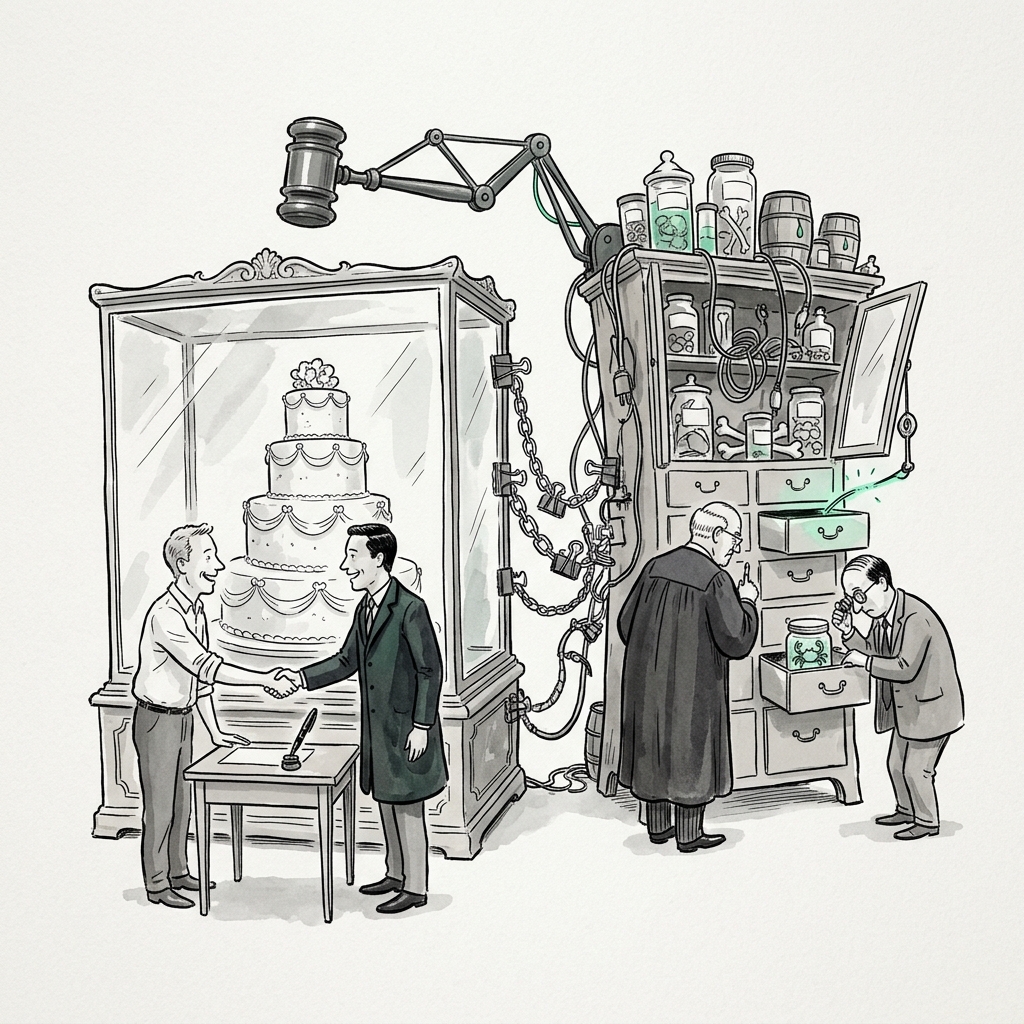
A stock purchase agreement disclosure schedule is the document where the seller lists every exception, item and fact that the representations in the SPA tell it to disclose. Its sections follow the numbering of the reps (Schedule 3.12 for material contracts, Schedule 3.15 for litigation, and so on), and whatever it lists either qualifies a rep or completes it. If the schedules are drafted well, the seller has fewer indemnity claims to answer after closing. If they are drafted badly, a single word like "None" can keep a fraud claim alive.
As of . Figures below are dated to their sources.
Key facts
| Fact | Value | Source | As of |
|---|---|---|---|
| Share of private-target deals with RWI (SRS Acquiom 2026 study) | approximately 46% | webiis10.mondaq.com | |
| Median escrow as share of deal value on RWI deals, 2024 to 2025 | 2.1% in 2024 to 2.8% in 2025 | webiis10.mondaq.com | |
| Average escrow, all deals, 2024 to 2025 | 10.25% to 12.1% | webiis10.mondaq.com | |
| RWI deals with no materiality scrape | 28.9% | webiis10.mondaq.com |
The SPA itself is mostly negotiated by lawyers from a precedent. The disclosure schedules are where the seller's real facts sit, and they are what buyers, insurers and Delaware judges go back to when something goes wrong. This guide walks through stock purchase agreement disclosure schedules section by section. For each section it covers what sellers list, gives example entries, and draws drafting lessons from recent Delaware decisions.
How Stock Purchase Agreement Disclosure Schedules Work
Each representation in the target's rep article ends in one of two patterns:
- Exception reps: "Except as set forth on Schedule 3.15, there is no Action pending against the Company." Anything listed here takes the item out of the rep.
- Listing reps: "Schedule 3.12 sets forth a true and complete list of each Material Contract." Here the schedule is the rep. If a contract is left off, the rep is breached.
Buyers rarely see schedules in public filings. Since the SEC's 2019 FAST Act amendments, Item 601(a)(5) of Regulation S-K has let registrants leave schedules and attachments out of every filed exhibit, provided they contain no material information. The registrant still has to file a list that briefly identifies the contents of what was left out, and it must provide the schedules to the SEC if asked (Arnold & Porter, April 2019). That is why so many merger agreements on EDGAR carry a line like "schedules omitted pursuant to Item 601(a)(5)," and why practitioners build schedules from internal precedent rather than from public examples.
Before anyone drafts a single entry, go through the rep article and tag each rep as an exception rep or a listing rep. The tag decides whether a blank section means "no exceptions" or "nothing to list," and those two readings carry different risks.
Stock Purchase Agreement Disclosure Schedules, Section by Section: What Sellers List
Section numbers differ from deal to deal, but most private-target SPAs follow the same order. Below are the core sections, what goes into each one, and an example entry in the style a seller's counsel would use.
Organization, Capitalization and Subsidiaries
- Jurisdictions where the company is qualified to do business.
- Authorized and issued shares by class, the holder of record for each, and every outstanding option, warrant, SAFE or convertible note.
- Each subsidiary, with its jurisdiction and ownership percentage.
An example entry reads "Schedule 3.3(a): 10,000,000 shares of Common Stock authorized; 6,250,000 issued and outstanding, held as set forth in Annex A. 412,500 shares reserved under the 2021 Equity Incentive Plan, of which 310,000 are subject to outstanding options listed in Annex B."
Financial Statements and Undisclosed Liabilities
- The financial statements delivered (audited year-end, unaudited interim).
- Off-balance-sheet liabilities, guarantees and indebtedness above the threshold set in the rep.
- Known internal control deficiencies or whistleblower allegations, if the accounting rep covers them.
Absence of Changes
This section lists events since the balance sheet date that the rep would otherwise catch: dividends, raises above a set percentage, capex above a dollar threshold, new debt, settled claims. Sellers tend to under-list here because the events feel like ordinary operations.
Material Contracts
- Every contract that meets the definitional triggers: annual spend or revenue above $X, exclusivity, non-competes, MFN clauses, change-of-control provisions, and related-party agreements.
- Any consents needed from counterparties to close, often split out into their own sub-schedule.
- Defaults, notices of termination, or contracts the company has been told will not be renewed.
One such entry reads "Schedule 3.12(a)(iv): Master Services Agreement dated March 1, 2022 between the Company and [Customer], as amended June 15, 2024. Section 14.2 requires counterparty consent to a change of control."
Intellectual Property
This section lists registered IP (patents, marks, domains), inbound and outbound licenses, open-source use that has copyleft exposure, and any infringement claims. It is also where cross-reference failures happen most often, as the next section shows.
Litigation, Employees, Benefits, Tax, Real Property and Insurance
- Litigation: pending and threatened actions, demand letters, and government inquiries, each with caption, forum and amount claimed.
- Employees: a census (name or ID, title, base pay, bonus, exempt status), union activity, and severance or retention agreements.
- Benefit plans: each ERISA plan and each equity, bonus or deferred compensation plan.
- Tax: jurisdictions where returns are filed, open audits, and any tax-sharing agreements.
- Real property: owned and leased sites, with lease dates and landlords.
- Insurance: policies, carriers, limits, and claims history.
Give each schedule section an owner inside the company (the CFO owns capitalization and financials, HR owns the census, the GC owns litigation and contracts) and a due date at least two weeks before signing.
Cross-References and the Word "None": Lessons From Delaware
The single most expensive drafting mistake in disclosure schedules is assuming that a disclosure in one section protects the seller everywhere else. Aldrich Capital Partners Fund, LP v. Bray, a Delaware Court of Chancery letter opinion dated May 17, 2024, shows why (Mayer Brown, January 2025). The target had disclosed an IP infringement lawsuit under Schedule 4.16(b) and cross-referenced it in 4.18. Schedule 4.16(a), which covered IP ownership, read "None." Schedule 4.25, on validity of material contracts, did not mention the lawsuit. The SPA said a disclosure applied to other sections when its relevance was "readily apparent on its face," but the introduction to the schedules limited cross-application to sections that were expressly specified.
The court denied the founder's motion to dismiss. In its view, a literal "None" could reasonably be read to block implied cross-references. It also held that the explicit cross-reference in 4.18 suggested the parties did not intend implicit ones, and that even under a "readily apparent" standard a disclosure probably qualifies only the reps it directly conflicts with (DealLawyers.com, May 2024).
Repetition protected the seller in SAM 1 Aggregator v. Mars Holdco, decided by Chancellor McCormick on August 25, 2025. The buyer alleged fraud over internal controls problems raised in a demand letter from the target's former CAO. The Disclosure Letter had listed the "Peter Owino Matter" against Section 2.2(f)(iii), the accounting process rep, and the matter appeared five times across the SPA. The court dismissed the fraud claims and rejected the buyer's argument that the disclosure reached only employment issues (DealLawyers.com, August 2025).
- Choose one cross-reference rule and make sure the SPA and the schedule preamble state it in identical words.
- Repeat important disclosures, or cross-reference them by section number, in every section a buyer could later argue is relevant.
- Use "None" only for a listing rep that is truly empty, and never next to a disclosure placed elsewhere that touches the same subject.
- Pick explicit or implicit cross-referencing for the whole document and do not switch between them.
Run a "related reps" check for each material item. For a lawsuit, that usually means the litigation rep, the IP rep, the contracts rep, the undisclosed liabilities rep, and the absence of changes rep.
Covenant Schedules: Interim Operating Carve-Outs
Schedules also qualify covenants, most often the interim operating covenant that limits what the target can do between signing and closing. These carve-outs need tight drafting. In the busted Williams/Energy Transfer merger, ETE argued that a disclosure schedule carve-out permitting a $1 billion securities offering also excused any breach of the ordinary-course and interim operating covenants that the offering caused. The Court of Chancery rejected that reading. On October 10, 2023 the Delaware Supreme Court affirmed, leaving in place the $410 million termination fee and a judgment that, according to Williams's counsel, exceeded $600 million in total (Cravath, October 2023; ABA Business Law Today, November 2023).
For a seller, the interim covenant schedule should list:
- Planned hires, terminations and raises, with headcount and dollar caps.
- Budgeted capex projects, with amounts.
- Contract renewals and pricing changes already being negotiated.
- Any financing, refinancing or equity issuance, together with the specific covenants each one is meant to excuse.
Write every covenant carve-out to name the covenant subsections it excuses. "Permitted under Section 6.1(b)(iii) and (vii)" will hold up in a way that "Permitted" will not.
Why Schedule Quality Shows Up in Deal Economics
Schedules sit beside the indemnity and insurance package, and market data shows how the two interact. SRS Acquiom's 2026 M&A Deal Terms Study covers more than 2,300 private-target acquisitions worth $569 billion that closed between 2020 and 2025 (SRS Acquiom). Fasken's May 2026 summary of the study reports the following (Fasken via Mondaq, May 2026):
- RWI was identified in approximately 46% of deals in the study.
- On RWI deals, the median escrow as a share of deal value rose from 2.1% in 2024 to 2.8% in 2025.
- Across all deals, average escrow rose from 10.25% to 12.1% of deal value.
- 28.9% of RWI deals included no materiality scrape at all, the highest share in three years.
On an RWI deal, the insurer underwrites against the schedules and excludes known matters. Anything the seller lists is effectively uninsured, and anything it fails to list becomes the basis for a claim against a policy whose retention may be paid out of the seller's escrow. On a non-RWI deal, the schedules directly decide what the seller's indemnity covers. In both cases the schedules are part of the price.
Find out early whether the buyer is binding RWI. If it is, give the underwriter the schedule drafts to review for exclusions before signing, not after the bring-down.
Building the Schedules Step by Step: A Seller's Workflow
- Extract the reps (Week 1). Copy every "except as set forth on" and "sets forth a list of" clause into a spreadsheet tracker, one row per rep and sub-rep.
- Assign owners and thresholds. Add columns for owner, dollar or headcount threshold, data source (data room folder), and status.
- Pull from the data room. Each listed contract, lawsuit and plan should point to a data room index number so the buyer can check it against the source document.
- Draft the preamble. Make the cross-reference standard match the SPA word for word. Add the usual disclaimers: inclusion is not an admission of materiality, and headings are for convenience only.
- Run the related-reps pass. Map every material item to each rep it touches and add the cross-references.
- Management certification. Have each owner sign off in writing. That record helps the seller rebut a later fraud claim.
- Bring-down update. Re-run the tracker before closing and check whether the SPA allows schedule supplements and whether those supplements cure breaches for indemnity purposes.
The tracker is the working tool, and the schedules are what it produces. A seller with a tracker in Excel that has a rep-to-schedule map can turn a buyer markup around in 48 hours instead of two weeks.
Conclusion: Draft the Schedules Like They Will Be Litigated
Every case above turned on drafting. In Aldrich v. Bray a "None" kept a fraud claim alive, while in SAM 1 v. Mars Holdco a disclosure repeated five times ended one. Energy Transfer lost the argument that a $1 billion carve-out covered more than it said. With RWI on roughly half of private deals and escrows getting larger, the schedules decide which risks the seller keeps, which the insurer excludes, and which the buyer can claim against. Starting from a ready-made disclosure schedule template and rep-to-schedule tracker means the section map, the preamble wording and the cross-reference checks are already in place, so the seller's team can spend its two weeks on the facts.
Sources
- Arnold & Porter, "SEC Adopts Disclosure Simplifications," April 2019
- Mayer Brown, "Delaware Law Alert: Avoiding Ambiguities in M&A Disclosure Schedules," January 7, 2025
- DealLawyers.com, "Del. Chancery Denies Motion to Dismiss Due to Ambiguities in Disclosure Schedule Language," May 2024
- DealLawyers.com, "Del. Chancery Points to Disclosure Schedules in Dismissing Fraud Claim," August 2025
- Cravath, "Williams Secures Delaware Supreme Court Victory Affirming Trial Win with $600 Million Judgment," October 2023
- ABA Business Law Today, "November 2023 in Brief: Corporations, LLCs and Partnerships," November 2023
- SRS Acquiom, 2026 M&A Deal Terms Study
- Fasken via Mondaq, "Private M&A Deal Trends to Watch: Key Takeaways from SRS Acquiom's 2026 Study," May 12, 2026
Related: Browse all Investment Banking & M&A Templates on ModelStack.
Get started with a free template
Download our free Unit Economics Calculator. No signup required.