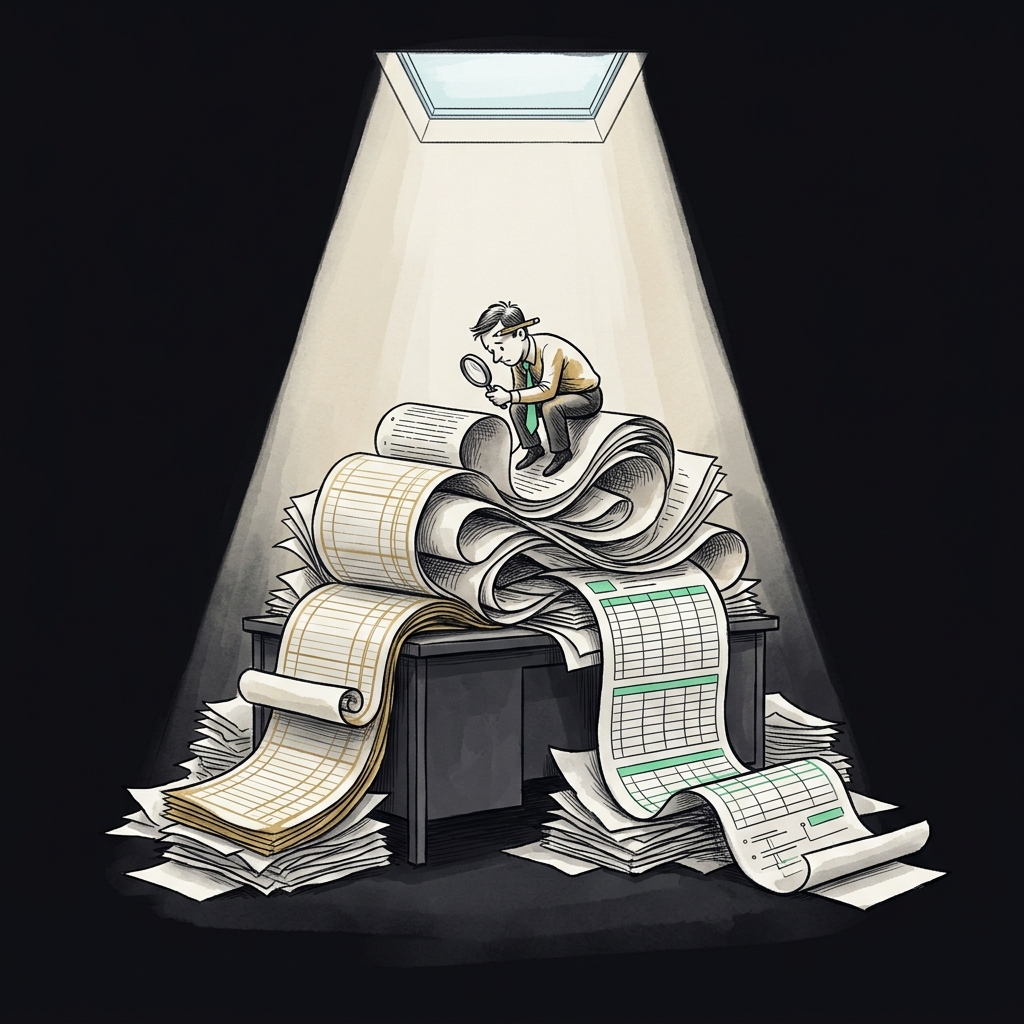
The SOP task granularity trap is the failure mode where a standard operating procedure specifies steps that sit below the reader's decision threshold — actions any competent operator would take without prompting — inflating the document with instructions that add noise, not signal. The fix is to write steps only where a real decision, judgment, or handoff exists, and to treat everything else as background craft. Get the granularity right and an SOP becomes a load-bearing tool; get it wrong and it becomes shelfware people skim, ignore, or work around.
This is not a stylistic complaint. Aviation, surgery, and manufacturing all learned the hard way that adding steps past a certain threshold degrades compliance rather than improving it. The World Health Organization's 19-item Surgical Safety Checklist, developed under Atul Gawande, cut inpatient mortality from 1.5% to 0.8% and reduced complications by more than a third across eight hospitals from London to rural Tanzania — with nineteen items, not ninety. This guide gives you a decision threshold you can apply to your own SOPs, a framework for calibrating step depth, a five-question audit for existing documents, and an example rewrite so you can see the shift.
What the SOP Task Granularity Trap Actually Looks Like
The trap has a signature. You inherit a "close-the-books" SOP that spans 47 numbered steps. Step 12 says "open Excel." Step 13 says "click File > Open." Step 14 says "navigate to the shared drive." Step 22 finally says "reconcile the intercompany suspense account to the trial balance and investigate variances greater than $5,000." Steps 12–14 are below the decision threshold — the reader knew how to open Excel before you hired them. Step 22 is the actual work. But because the document treats them as peers, the reader either skims the whole thing (missing step 22's judgment call) or follows it robotically (learning nothing about why $5,000 is the threshold).
The pattern shows up everywhere procedures are written: onboarding runbooks that instruct new hires to "check email daily," sales playbooks that list "greet the customer" as step one, IT tickets that document "log into the VPN" before the actual troubleshooting begins. The intent is defensiveness — if we write it down, no one can claim they didn't know. The effect is dilution. Nielsen Norman Group's eye-tracking research on scannability shows readers process web content in an F-pattern, skimming heavily after the first two or three lines of any block; a 47-step list is functionally read as a 5-step list of whatever caught the eye first.
Takeaway: Before you write the next SOP, ask what the reader already knows. If a step would embarrass a competent professional, it belongs in onboarding, not in a running procedure.
The Decision Threshold: A Rule for Every Step
Borrow the aviation model. FAA Advisory Circular 120-71B, which governs flight-deck standard operating procedures, splits every action a pilot takes into three tiers: memory items (bold-face, must be done from recall before touching a checklist), normal-checklist items (challenge-and-response, done from a printed list), and reference items (looked up in the Quick Reference Handbook only when the situation calls for them). The categorization is the SOP. A step earns its place in the checklist only if it meets a specific test.
Adapt that test to business SOPs. A step belongs in the document if and only if one of the following is true:
- It is critical and skippable. The task materially affects the outcome, and a competent operator could plausibly forget or defer it under load — the same criterion EHS Insight and other procedure-writing guides converge on.
- It requires a non-obvious judgment. There is a threshold, a decision rule, or a branch. "Investigate variances greater than $5,000" qualifies. "Open Excel" does not.
- It must be tracked for audit or compliance. Someone downstream — an auditor, a regulator, a QA reviewer — needs evidence the step happened.
- It is a handoff. Ownership passes from one person, team, or system to another, and the SOP is the contract that governs the transition.
Every other candidate step is craft — background competence the reader is presumed to have. Craft belongs in training, in a glossary, in an appendix, or nowhere. Not in the running procedure. This is the same logic Toyota codifies in the Training Within Industry Job Instruction breakdown, where the Job Breakdown Sheet captures Important Steps, Key Points, and Reasons — but only the Key Points, the moves that "make or break the job, injure the worker, or make the work easier," get taught in the four-step JI method. Everything else is assumed.
Takeaway: Write down the four-criterion test on a sticky note. Before adding any step to any SOP, force it to pass one of the four. If it doesn't, cut it.
Why the Trap Persists: Three Structural Incentives
If over-granular SOPs waste reader attention, why does every organization drift toward them? Three incentives push in the wrong direction, and naming them makes them easier to resist.
- Defensive documentation. The person writing the SOP often owns the risk if the process fails. Adding a step feels safer than omitting one, because omissions get punished when things go wrong and inclusions rarely get punished for waste. This is the same asymmetry that inflates airline safety cards and pharmaceutical package inserts.
- The illusion of transferability. An over-detailed SOP feels like it can onboard anyone. In practice, it substitutes for training that never happened. McKinsey Global Institute research found knowledge workers already spend roughly 1.8 hours per day — nearly a quarter of the workweek — searching for information; adding thirty rote steps to every SOP compounds that tax rather than relieving it.
- Confusion between SOPs, training materials, and reference guides. These are three different documents serving three different readers at three different moments. When they collapse into one, the SOP inherits the exhaustiveness of the training manual and the depth of the reference guide, and loses the terseness that makes it usable in the moment.
Takeaway: Split your documentation into three artifacts — SOP (what to do in the moment), training (how to become someone who can do it), reference (where to look when the unusual happens). Stop making one document carry all three loads.
A Calibration Framework: The Five-Question Audit
Use this on any existing SOP that feels bloated. Walk through it step by step and apply five questions. If a step fails all five, delete it or move it to training.
- 1. Would a competent hire, on day 30, do this without being told? If yes, the step is craft. Cut.
- 2. Is there a threshold, rule, or branch here? If yes, keep the step and explicitly name the threshold ("$5,000," "24 hours," "over 3 line items"). The threshold is the whole value.
- 3. Does this step generate an artifact someone else consumes? If yes, keep it and name the artifact and the consumer.
- 4. Would skipping this step create a defect that is hard to detect later? If yes, keep it — this is a "make-or-break" Key Point in TWI-JI terms.
- 5. Is this step legally, contractually, or audit-required? If yes, keep it and cite the requirement inline so the reader understands why.
Applied ruthlessly, this typically cuts a 40-step SOP down to 8–15 meaningful steps. That is not a loss of rigor. It is the rigor. The WHO Safe Surgery Checklist is 19 items across three phases (sign-in, time-out, sign-out) for the entire surgical operation, from anesthesia to closure. If a nineteen-item checklist can meaningfully reduce mortality in an operating room, your accounts-payable SOP does not need forty-seven items.
Takeaway: Schedule a two-hour SOP audit for your most-referenced procedure this month. Run the five questions. Publish the leaner version. Measure whether compliance and completion time improve.
Rewriting an Over-Granular SOP: A Before-and-After
Here is the pattern applied to a common procedure — the monthly close for a small finance team.
Before (32 steps, actual excerpt)
- Open your laptop
- Log into the accounting system
- Click "Reports"
- Select "Trial Balance"
- Set the date range to the prior month
- Click "Run"
- Export to Excel
- Open Excel
- Save the file to the shared drive
- Compare cash balance to bank statement
- ...
After (9 steps, decision-threshold applied)
- Pull the prior-month trial balance from the accounting system and save it to
/Finance/Close/YYYY-MM/. - Reconcile cash to bank statements. Investigate any variance over $500 before proceeding. Document root cause in the recon worksheet.
- Reconcile intercompany suspense to trial balance. Any open item older than 30 days escalates to the controller.
- Recognize revenue per the standing schedule. Any contract signed after the 25th requires a signed acknowledgment from Sales before revenue is booked.
- Accrue payroll, commissions, and known vendor liabilities using the accrual worksheet. Commissions over $10,000 require sales-ops sign-off.
- Book prepaid amortization and deferred revenue rolls. Cross-check against the deferred schedule; variance >$1,000 blocks close.
- Produce draft P&L, balance sheet, and cash flow. Post to
/Finance/Close/YYYY-MM/Drafts/and tag the CFO in Slack. - Resolve CFO review comments. All comments must be closed or explicitly deferred to the next close with a written note.
- Publish final financials and email the leadership distribution list. Archive supporting workpapers to the read-only close folder.
Notice what the shorter version does. Every step names a threshold, an artifact, a handoff, or an escalation rule. Nothing describes how to click a menu. The document is now a decision map, not a keystroke log. A new hire needs training and a mentor to run this — as they should. A veteran can execute it in the moment without re-reading the parts they already know cold.
Takeaway: When you rewrite an SOP, delete every verb that a smartphone tutorial would use ("click," "open," "select," "navigate") unless the click is the decision. Replace them with verbs of judgment: reconcile, escalate, approve, block, publish, resolve.
The Compounding Cost of Getting This Wrong
Bloated SOPs do not fail loudly. They fail quietly, in three ways that add up over quarters.
- Attention tax on every read. If your team runs a procedure weekly and each read wastes three minutes on trivial steps, that is roughly 2.6 hours per person per year lost to noise. Across a 20-person team, that's a full FTE-month gone to procedural filler.
- Compliance erosion. Aviation safety research collected by SKYbrary and NASA on flight-deck checklist design consistently finds that over-long checklists get "chunked" by pilots — read as blocks and confirmed as blocks — which is exactly the failure mode that skipping a critical item requires. The same happens in every enterprise SOP: readers skim, satisfice, and eventually stop reading at all.
- Drift from the actual work. Because the SOP is boring to read, it is also boring to maintain. Steps 12–14 stay the same for years while step 22 — the one with the actual judgment — quietly changes as the business evolves. The document becomes wrong in the parts that matter and pedantically correct in the parts that don't.
Takeaway: Treat SOP length as a leading indicator. When a procedure grows past 15 steps for a single operator's job, run the five-question audit before it becomes shelfware.
Conclusion: The SOP as Load-Bearing Document
A good SOP is a contract between the operator and the organization. It says: here are the decisions we require you to make, the thresholds we ask you to respect, the artifacts we need you to produce, and the handoffs we hold you to. Everything else is craft, and craft belongs to the operator. This is the model used by the WHO Surgical Safety Checklist, by FAA Advisory Circular 120-71B, and by Toyota's Job Instruction breakdown — three of the most consequential procedural documents in the world, none of them over-granular.
Building an SOP library from scratch is a discipline, and it is faster to start from templates that already respect the decision threshold than to relearn the lesson on your own timeline. ModelStack's SOP and consulting template kits are structured this way by default: numbered steps that map to decisions, thresholds called out inline, artifacts named, handoffs explicit. Whether you buy them, adapt them, or use them as a reference for rewriting what you already have, the goal is the same — an SOP short enough to actually be read, and precise enough to actually be followed.
Sources
- Harvard T.H. Chan School of Public Health — A simple checklist that saves lives (WHO Safe Surgery Checklist, mortality reduction from 1.5% to 0.8%)
- FAA Advisory Circular 120-71B — Standard Operating Procedures and Pilot Monitoring Duties for Flight Deck Crewmembers
- NASA Ames Research Center — Human Factors of Flight-Deck Checklists: The Normal Checklist (NASA Contractor Report 177549)
- Art of Lean — Job Instruction (TWI-JI): Important Steps, Key Points, and Reasons in the Job Breakdown Sheet
- Lean Competency System — Succeeding with Work Method Standardisation Using TWI Job Instruction
- McKinsey & Company — Boosting the productivity of knowledge workers
- EHS Insight — How to Write Standard Operating Procedures: Tips and Best Practices
- SKYbrary Aviation Safety — Checklists: Purpose and Use
Related: Browse all SOP Templates for Small Business on ModelStack.
Get started with a free template
Download our free Unit Economics Calculator — no signup required.