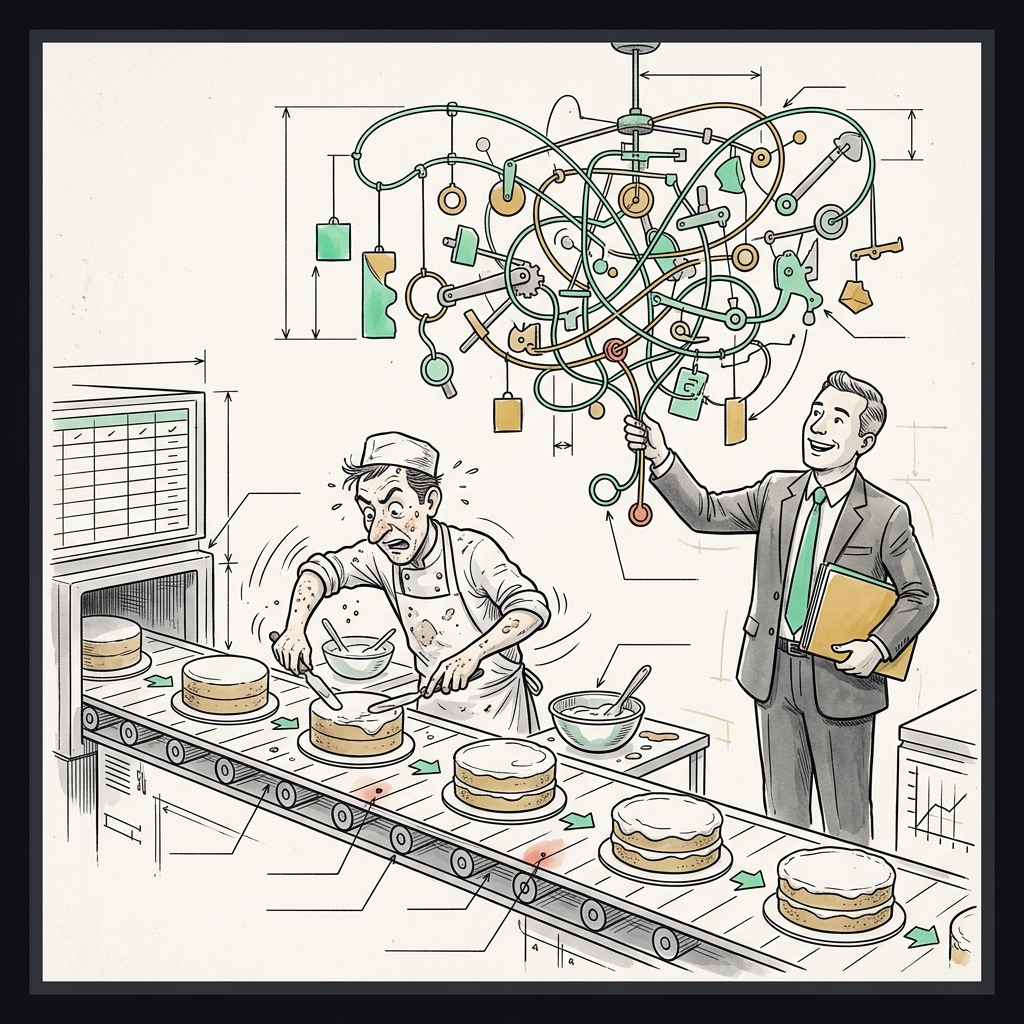
SOP checklists and flowcharts do different jobs. A checklist makes sure someone who already knows the work does every step in a fixed order and skips none. A flowchart shows someone which path to take when the work branches on a decision. Front-line staff follow checklists far more reliably for routine, high-volume tasks, and they need flowcharts only where a wrong decision matters more than a missed step.
Most operations teams pick a format out of habit, not because it fits the task. Quality leads like swimlane diagrams. Managers who came up through hospitality or aviation like tick-boxes. The result is a binder of SOPs that nobody opens during a shift. This guide sets out what the public evidence says, gives you a step by step rule for choosing between the two, and shows how to build a hybrid your team will use.
SOP Checklists vs Flowcharts: What Each Format Is Built to Do
The American Society for Quality defines a flowchart as a process map that "visually represents the steps of a process, system, or workflow in sequential order," using symbols and arrows to show inputs, outputs, decisions and the people involved. ASQ lists it among its basic quality tools and positions it mainly for problem solving and process improvement, meaning for people analysing a process from the outside.
A checklist is a memory aid for the person doing the work. The modern pilot's checklist dates to 30 October 1935, when Boeing's Model 299 prototype (the future B-17) stalled after takeoff at Wright Field and crashed, killing two of the five crew. Investigators traced the crash to a pilot who forgot to release the elevator gust lock. Boeing's response was a short list of critical checks for taxi, takeoff and landing, built on the view that the aircraft was too complicated to be left to a pilot's memory rather than too complex to fly. According to the Air Traffic Control History archive, pilots then flew the first 12 aircraft 1.8 million miles without an accident.
The distinction for SOP design:
- Checklists guard against omission. They assume the operator is competent and distracted.
- Flowcharts guard against wrong choices. They assume the operator faces a branch they may not have seen before.
- Checklists are read at the point of work, often mid-task, often in seconds.
- Flowcharts are read before the work, during training, or when something has gone off-script.
Takeaway: Before you draft any SOP, write one line at the top that says whether the main risk is "someone skips a step" or "someone takes the wrong branch." That line picks your format.
What the Evidence Says About Checklist Compliance
The strongest public data on front-line procedure adherence comes from healthcare, where outcomes are measured and published.
Case 1: Keystone ICU, Michigan
Peter Pronovost and colleagues at Johns Hopkins ran the Keystone ICU project across Michigan hospitals with a five-item checklist for inserting central lines: hand hygiene, full sterile barriers, chlorhexidine skin prep, avoiding the femoral vein, and removing unnecessary catheters. According to AHRQ's Patient Safety Network, central line bloodstream infections fell 66%, and the reduction held for more than three years. Over 18 months, the infection rate dropped from 7.7 to 1.4 per 1,000 catheter days, with an estimated 1,500 lives and $175 million saved.
Case 2: WHO Surgical Safety Checklist
In January 2009, the New England Journal of Medicine published Alex Haynes and colleagues' study of the 19-item WHO Surgical Safety Checklist across eight pilot hospitals. Complications fell from 11.0% to 7.0%, and in-hospital deaths fell from 1.5% to 0.8%. The Harvard Gazette summarised this as a drop of more than one-third. Haynes noted that clinicians who started out sceptical became advocates once they saw the results.
Case 3: Ontario, the counter-example
In March 2014, NEJM published David Urbach's study of Ontario's province-wide rollout. Across 101 hospitals and more than 215,000 procedures, adjusted mortality moved from 0.71% to 0.65%, and complications moved from 3.86% to 3.82%. Neither change was statistically significant. The same checklist format produced very different results depending on how it was introduced and whether teams actually ran it.
For operators, the lesson from these three cases is that a checklist works when it is short, tied to a specific moment in the task, and owned by the people using it. A mandate from head office with a new form attached does not get you there. Keystone used five items. The WHO list has 19, but they are split across three pause points (before anaesthesia, before incision, before the patient leaves the room), so no single block runs long.
Takeaway: Count the items in your longest SOP checklist block. If one pause point has more than ten items, split it at a natural break in the physical work.
Where Flowcharts Beat Checklists on the Floor
Checklists break down when the next step depends on a condition. A returns desk, a warehouse exceptions process, or a first-line IT support script all branch: if the item is damaged, go here; if the receipt is missing, go there. Squeezing that into a checklist gives you nested "if applicable" lines that staff skip.
ASQ's guidance covers this case. Flowcharts show "decisions that must be made" and "people who become involved," which a linear list cannot show. Use a flowchart when:
- The process has two or more decision points that send the worker down different paths.
- A handoff to another role or team happens partway through, and staff need to see where their part ends.
- The task is rare, so staff will not have a practised sequence in memory.
- The cost of a wrong branch (refunding a fraudulent return, escalating the wrong ticket) is higher than the cost of a slow one.
Flowcharts have one weakness on the floor. They are hard to scan mid-task. Nielsen Norman Group's 1997 study found that 79% of test users scanned any new page and only 16% read word-by-word. A dense diagram with fifteen diamonds and crossing arrows gives a scanning eye nowhere to land. NN/g also found that concise text improved measured usability by 58% and scannable layout by 47%, and that combining several such improvements raised it by 124%. Those numbers come from web reading, but they match what you see when a shift lead holds a laminated A4 sheet with one hand.
Takeaway: If your flowchart has more than five decision diamonds, it is really two or three processes. Break it at the first major branch and give each path its own page.
A Step by Step Rule for Choosing Between SOP Checklists vs Flowcharts
Run every SOP through this sequence. It takes about ten minutes per process and keeps you from defaulting to whichever format the last person used.
- List the failure modes. Pull the last 90 days of incidents, customer complaints or QA findings for the process. Tag each one as "omission" (step skipped) or "commission" (wrong choice made).
- Count the branches. Walk the process with the most experienced operator and mark each point where the next action depends on a condition. Zero or one branch means a checklist. Three or more means a flowchart.
- Measure frequency. A task done ten times a shift becomes muscle memory within a week. That favours a do-confirm checklist. A task done once a quarter favours a flowchart or a read-do checklist.
- Identify the reading moment. Decide whether staff will look at the SOP before, during or after the task. During-task reading needs a checklist. Before-task reading can carry a flowchart.
- Pick read-do or do-confirm. Flight Safety Australia's history of the checklist describes the aviation norm: pilots complete a memorised flow, then run the checklist to confirm. When crews skip the flow and treat the checklist as read-do, anything not on the list gets missed. For experienced staff, write do-confirm lists. For new hires or rare tasks, write read-do lists.
- Pilot with one shift. Hand the draft to one team for a week. Count how many times it was used, what got crossed out, and what got scribbled in the margin.
Here is how the rule plays out for a restaurant group:
- Opening line check: 12 items, zero branches, done daily, read during the task. Do-confirm checklist.
- Allergen order handling: 3 branches (declared allergy, cross-contact risk, guest unsure), done several times a shift, commission errors are severe. One-page flowchart posted at the pass, with a 4-item checklist at the end.
- Walk-in cooler failure: 4 branches, happens once or twice a year. Flowchart in the manager binder plus a read-do checklist for the first 15 minutes.
Takeaway: Add a "Format rationale" column to your SOP register (an Excel template or Google Sheet works fine) and record the branch count, frequency and failure mode for each process. When someone asks why a procedure looks the way it does, the answer is already written down.
Building the Hybrid: Flowchart for Decisions, Checklist for Execution
The WHO surgical checklist already works as a hybrid. It is three short checklists placed at fixed points inside a longer process that clinicians already understand. You can copy that structure for any front-line SOP.
The one-page hybrid layout
- Top third: trigger and scope. One sentence on when this SOP applies, one on who owns it, and one on what "done" looks like.
- Middle third: decision map. A flowchart with no more than four diamonds. Each end point is labelled with a checklist letter (A, B, C).
- Bottom third: execution checklists. Checklists A, B and C, each under ten items, each starting with a verb, each fitting in a single column.
Writing rules that raise compliance
- Start every item with a verb: "Confirm," "Log," "Seal." Leave out anything that is only background.
- Cut items that staff never miss. Gawande's point, quoted by Flight Safety Australia, is that bad checklists are "too long," "hard to use" and "impractical." Keep the steps that people actually skip.
- Put the "killer items" (the ones that caused past incidents) first in each block, in bold.
- Print at a size readable at arm's length. If staff have to lean in, they will skip it.
- Give each checklist a named owner and a review date. The Ontario result shows how fast a mandated form turns into paperwork.
Rollout sequence
- Draft with two front-line operators in the room, not only supervisors.
- Run a one-week pilot on a single shift or site.
- Cut every item that was ticked 100% of the time with no near-misses, and add any item that shows up in handwritten margin notes.
- Roll out site by site. Get supervisors to watch the first ten uses in person.
- Review at 30 and 90 days against the incident log from Step 1 of the selection rule.
Takeaway: Pick your highest-incident process this week and rebuild it on the one-page hybrid layout. Measure incidents for 30 days against the previous 90-day baseline.
Turning the Format Decision Into a Repeatable System
The public record points one way. Short, pause-point checklists owned by the people doing the work cut errors sharply, as Keystone and the WHO pilot showed. The same tool rolled out as a compliance form can produce no measurable change, as the Ontario study found. Flowcharts belong where the risk is a wrong decision, and they stay usable only when they are small enough to scan.
Most teams do not get this wrong on purpose. They get it wrong because every SOP starts from a blank page, formatted however the author prefers. A standard template fixes that. Use one SOP spreadsheet model with the format rationale fields built in, one checklist layout with verb-first items and pause-point blocks, and one flowchart layout capped at four decisions. With those in place, a new procedure takes an afternoon, and every procedure across your sites looks the same, so staff know where to look.
ModelStack's SOP and operations templates are built on this structure: an SOP register with format selection logic, ready-to-edit checklist and hybrid flowchart layouts, and a rollout tracker for the 30 and 90-day review. Start with your highest-incident process, apply the rule above, and use the template as the standard every future procedure follows.
Sources
- Haynes et al., "A Surgical Safety Checklist to Reduce Morbidity and Mortality in a Global Population," New England Journal of Medicine, January 2009
- Harvard Gazette, "Surgical safety checklist drops deaths and complications by more than one-third," January 2009
- Urbach et al., "Introduction of Surgical Safety Checklists in Ontario, Canada," NEJM via PubMed, March 2014
- AHRQ Patient Safety Network, "Sustaining reductions in central line-associated bloodstream infections in Michigan intensive care units"
- Air Traffic Control History, "How the Pilot's Checklist Came About"
- Flight Safety Australia, "One thing at a time: a brief history of the checklist," November 2018
- ASQ, "What is a Flowchart? Process Flow Diagrams & Maps"
- Nielsen Norman Group, "How Users Read on the Web," 1997
Related: Browse all SOP Templates for Small Business on ModelStack.
Get started with a free template
Download our free Unit Economics Calculator — no signup required.