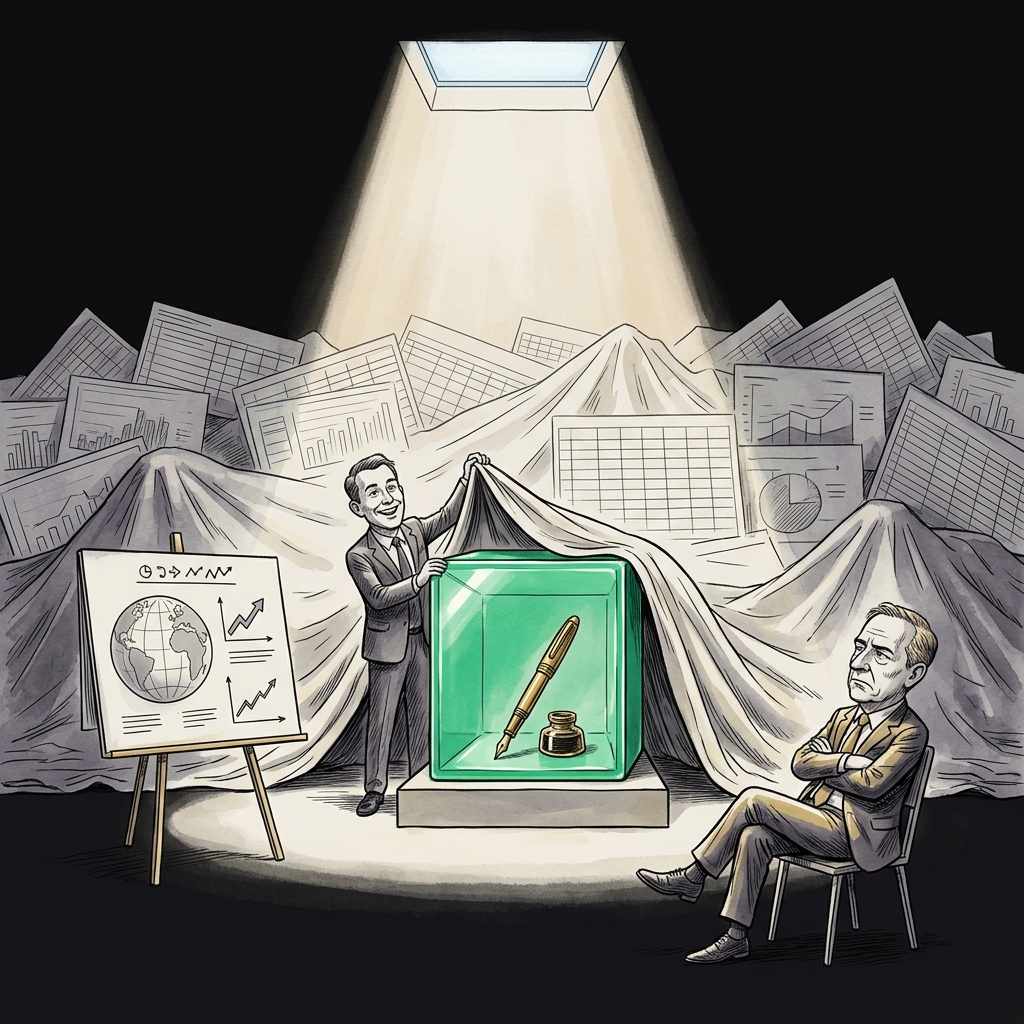
Pitch deck problem slide specificity is the practice of naming one concrete customer segment and the exact pain they experience today, instead of describing a whole industry and its abstract inefficiencies. Investors give a deck an average of 3 minutes and 44 seconds of attention (DocSend/Harvard Business School, 2015), so a problem slide that names "eBay PowerSellers processing more than $1,000 in monthly volume" beats one that says "online payments are broken" every time. The specificity signals founder-market insight, focuses execution, and makes the wedge into a larger market believable.
Why Pitch Deck Problem Slide Specificity Wins
Founders lose problem slides for one reason: they conflate market size with problem clarity. A slide that starts with "SMB commerce is a $XT market" tells an investor nothing about who hurts, how much, and why nobody has solved it. It also tells the investor that you have not talked to enough real customers to name one.
Peter Thiel's Zero to One (2014) makes the counterintuitive case explicit: "The perfect target market for a startup is a small group of particular people concentrated together and served by few or no competitors." PayPal did not launch as "the future of online payments." It launched by dominating roughly 20,000 eBay PowerSellers — a named segment with a named workflow (auction settlement) and a named alternative (mailed cashier's checks). The problem slide, had they written one, would have fit on a Post-it.
Compare that to Airbnb's 2008 seed deck. The problem slide named three specific pains: price, hotel disconnection from local culture, and the absence of an easy way to book a room in someone's home. It did not open with "travel is a $1.4T industry." It opened with what a specific traveler feels the night they book.
Takeaway: If you cannot write your problem slide without a market-size number, you do not yet have a problem slide. You have a TAM slide misfiled.
The Segment-First Framework: A Step by Step Rewrite
Use this five-step process to convert a generic problem slide into a segment-first one. Do it in an Excel template or spreadsheet model so you can iterate — this exercise is worth two hours of a founder's time even if you already have a deck.
- Name one segment in fewer than 12 words. Include role, company stage, and volume. Bad: "sales teams." Good: "Series B SaaS Heads of Revenue Ops managing 8–20 AEs." Rahul Vohra's Superhuman team gave their segment a name — "Nicole" — and defined her as an executive, founder, or business developer handling 100–200 emails a day and sending 15–40 responses. Everyone at the company could pattern-match against Nicole in a hallway conversation.
- Write the pain in the segment's own vocabulary. If your segment says "pipeline meeting," do not translate it to "revenue attribution reviews." Interview 10 people in the segment and steal the exact phrase they repeat.
- Quantify the pain in the unit the segment tracks. Hours per week, dollars per deal, points of margin, days-to-close. Vague: "wastes time." Specific: "spends 6.5 hours per week reconciling Salesforce, Gong, and Clari before every Monday forecast call."
- Name today's workaround. Every real problem has an incumbent solution — usually a spreadsheet, an intern, or a Zapier chain. Name it. This is the single most credibility-building sentence on the slide because it proves the pain is worth paying to solve.
- State why now. Why this segment, why this pain, why 2026 and not 2019. Regulatory shift, model-cost collapse, new distribution channel, generational buyer change.
Takeaway: A problem slide that survives this five-step edit will almost always shrink, not grow. Shrinking is the point.
What the Sequoia Capital Pitch Deck Template Actually Asks For
Sequoia's canonical pitch deck template — the one every seed founder downloads as a free download from Slidebean, SlideShare, and dozens of mirror sites — is more prescriptive than most founders realize. The Problem slide instructs founders to "describe the pain of the customer" and to "outline how the customer addresses the issue today." Two clauses. Neither of them says "size the market."
The template implicitly demands segment-first framing because it forces you to write in the singular: the customer, not customers. If you cannot write the sentence "Our customer is a ______ who currently ______ and hates it because ______," the slide is not ready.
Founders who use the Sequoia format well tend to follow three unwritten rules:
- One segment per deck, not per slide. If the problem slide names one buyer but the pricing slide implies three, the deck reads as unfocused. Pick the wedge segment and let every other slide reinforce it.
- The workaround gets equal billing with the pain. "They currently use Google Sheets with 47 tabs" is worth more than "they lack visibility." Show, don't adjective.
- Numbers describe the segment, not the market. Save the $XB TAM for the Market slide. On the Problem slide, quantify segment behavior: "the average Nicole receives 189 emails per day."
Takeaway: The Sequoia template is not asking for a mini-consulting deck. It is asking for a portrait of one person in pain.
The Stripe Example: Segment Specificity as Distribution Strategy
When Patrick and John Collison built Stripe in 2010, they did not pitch "the future of internet payments." They pitched a very specific segment: other Y Combinator founders shipping developer-facing products who needed to accept credit cards without a two-week PayPal integration or a Bank of America merchant account application. Stripe's first roughly 20 customers were pulled directly from the YC network, and the Collisons developed what Paul Graham later called the "Collison installation" — asking a founder for their laptop and setting up Stripe on the spot.
The segment-first problem statement gave Stripe three compounding advantages that a broad "payments are hard" framing would have destroyed:
- Distribution was pre-mapped. Every YC founder knew every other YC founder. A named segment doubles as a named channel.
- The MVP could be narrow. Seven lines of JavaScript were enough because YC founders were technical. A "small business owner" segment would have required a hosted checkout, a dashboard, and phone support before day one.
- Word of mouth had a substrate. When YC president Garry Tan posted about Stripe on Hacker News, the message landed in a room where the specific pain was universal. A generic "payments" message on the same forum would have died.
The pitch deck problem slide specificity, in Stripe's case, was operational strategy — not marketing polish. Naming the segment shrank the surface area of everything the company had to build in year one.
Takeaway: A named segment on the problem slide will save you two engineers of hiring in year one because it lets you cut every feature the segment does not need.
Common Failure Patterns and How to Fix Them
These are the six patterns that appear most often in first-draft problem slides. Each has a one-line fix.
- "We serve SMBs." SMB is not a segment — it spans a five-person law firm and a 400-person franchisor. Fix: pick one NAICS code, one revenue band, and one buyer title.
- "The market is broken." Markets are not the customer. Fix: name the human who feels the break and what they Slack their boss about it.
- "Existing solutions are outdated." Outdated compared to what? Fix: name the specific incumbent (HubSpot Service Hub, Zendesk, Excel) and the specific way it fails your segment.
- "AI will change everything." This is not a problem — it is a supply-side observation. Fix: name what your segment does today that AI now makes 10x cheaper, and quantify the delta.
- "We're building the [big company] of [category]." Analogy is not specificity. Fix: describe the workflow your customer runs on Tuesday afternoon and where it breaks.
- A problem slide with more than 40 words. If it does not fit on one breath, an investor scanning at 3 min 44 sec will skip it. Fix: cut to three bullets with one number each.
Takeaway: The fastest edit is a word count. If your problem slide has more than 40 words or more than one segment, cut before you do anything else.
Putting It Together: The One-Page Problem Slide Test
Before you send your deck to a single investor, run this test. Print the problem slide alone. Hand it to someone who has never heard your pitch. Ask them three questions:
- Who is the customer? (They should be able to name a job title and a company stage.)
- What do they do today when they hit this pain? (They should be able to name the workaround.)
- Why is this urgent in 2026? (They should be able to name a shift — regulatory, technological, or generational.)
If they cannot answer all three from the slide alone, the slide is not done. The DocSend data is unforgiving: investors spend 111 seconds on the average deck. If the problem slide burns 30 of those seconds without answering these three questions, the meeting is over before the traction slide loads.
The reason ready-made investor deck templates matter here is not aesthetics — it is discipline. A well-structured Excel template or spreadsheet model for pitch deck development enforces the segment-first constraint by giving you fixed word counts, forced fields for named customer and named workaround, and a comparison column against Airbnb, Stripe, and Sequoia-formatted decks. ModelStack's pitch deck and investor materials templates include exactly this structure — a fill-in-the-blank problem slide worksheet, a segment-definition scorecard modeled on Superhuman's HXC survey, and a one-page example gallery drawn from the decks that actually raised. The point is not to copy the format. The point is to be forced, on page one, to name one customer instead of describing a whole market.
Sources
- TechCrunch: Lessons from a study of perfect pitch decks — VCs spend an average of 3 minutes 44 seconds on them (DocSend / Harvard Business School study), June 2015
- First Round Review: How Superhuman Built an Engine to Find Product/Market Fit — Rahul Vohra on the "Nicole" HXC segment
- Sequoia Capital Pitch Deck Template (PDF, University of Victoria mirror)
- Airbnb Original Pitch Deck from 2008 (SlideShare)
- Just Go Grind: The First Few — Stripe (Collison brothers, YC founders as first ICP, "Collison installation")
- Forbes: The Collison Brothers Built Stripe Into A $95 Billion Unicorn, May 2022
- Achieving Monopoly: Unpacking Zero to One by Peter Thiel — PayPal's eBay PowerSellers wedge
- DocSend: What VCs Really Want to See Inside Your Seed Deck
Related: Browse all VC & Startup Templates on ModelStack.
Get started with a free template
Download our free Unit Economics Calculator — no signup required.