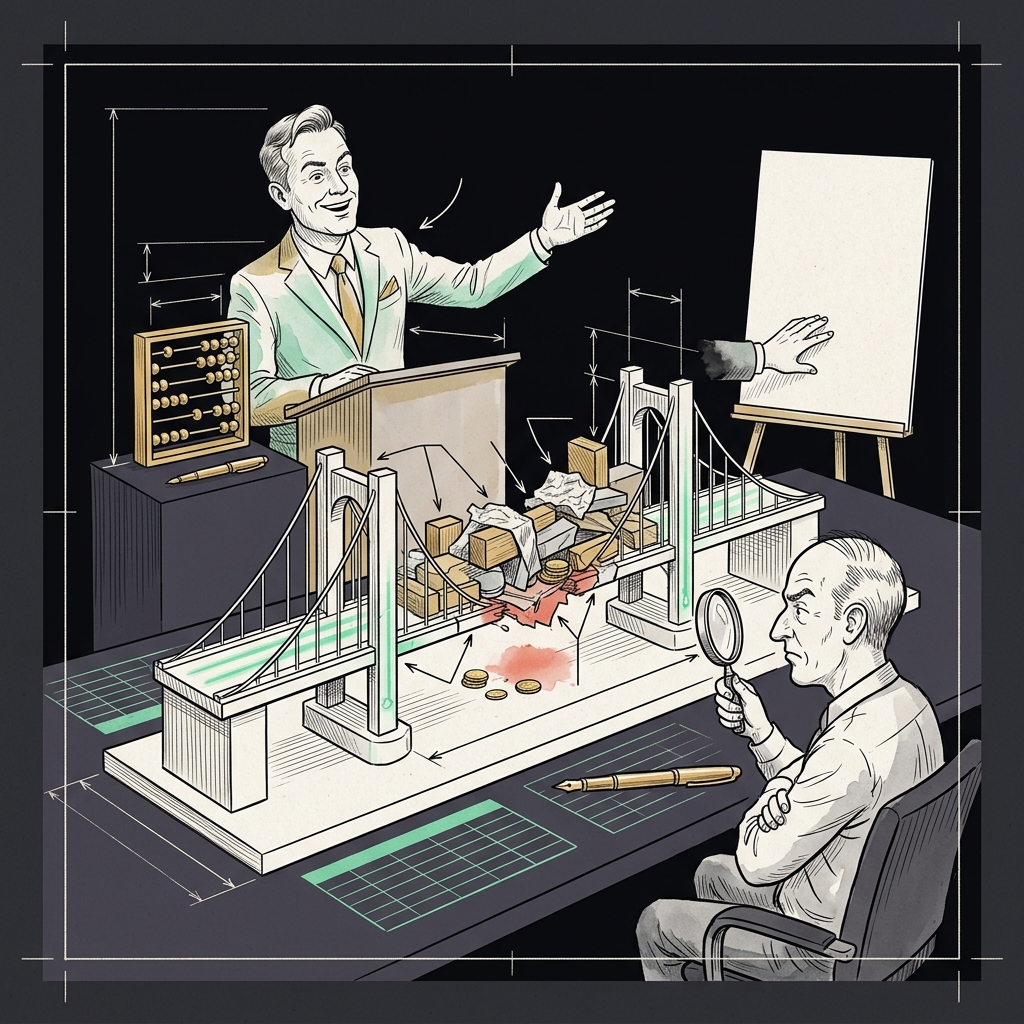
A pitch deck ask slide is the single slide where a founder states the exact dollar amount being raised, the instrument, and the milestones that capital will unlock — usually 18 months out. When that number is vague ("we're raising $2M–$5M") or unmoored from a burn model, sophisticated investors read it as evidence the founder has not built the operating plan behind the round. Precision on the ask is not a formatting nicety; it is the shortest proof-of-work you can offer that your 18-month plan actually exists.
Why the Pitch Deck Ask Slide Is a Diligence Signal, Not a Formality
Investors do not open the ask slide expecting inspiration. They open it to test whether the numbers on your financial model tie back to your growth story. Haje Jan Kamps at TechCrunch put it bluntly in his 2022 breakdown of the ask slide: "you are raising money to hit a certain set of milestones, not to get 18 months of runway." A range like "$2M–$5M" is often interpreted as "I have no idea what I need," because the difference between $2M and $5M is roughly the difference between three engineers and eight, or between a domestic launch and an international one. Those are different companies.
Sequoia Capital, whose pitch deck template has been dissected by every founder who has raised a seed since 2009, treats the ask as the closing argument of the whole deck. Each preceding slide — problem, market, product, traction, competition, team — is evidence. The ask is the demand you place on that evidence. If the number is fuzzy, the argument collapses. This is why the 2009 Airbnb seed deck that raised $600,000 from Sequoia is still studied: Brian Chesky, Joe Gebbia and Nathan Blecharczyk stated the raise, the valuation, and the specific market goals it funded, and did not leave the reader to guess.
Takeaway: Treat the ask slide as the destination the rest of the deck argues toward. If you cannot state one number with conviction, the deck behind it is not yet finished.
The 18-Month Rule and Why the Ask Slide Enforces It
The 18-month runway benchmark is not a superstition — it is what the current data on time-to-Series-A demands. Carta's 2025 State of Seed report shows the median seed round in the United States is now roughly $4 million on a $20–24 million post-money valuation, and SaaStr's analysis of 3,365 startups on Carta found that seed-to-Series A now takes closer to 30 months than the pre-2022 norm of 18. That means the seed check has to carry the company through a longer, harder gap.
Practically, this changes what a precise ask slide has to show:
- Monthly net burn at close, not average burn over the round.
- The specific Series A metric you are underwriting to — typically $1–$2M ARR for SaaS, per Runway's 2026 burn-multiple benchmarks.
- Burn multiple (net burn ÷ net new ARR) at target, which 56% of seed investors surveyed by Runway now call a critical metric — under 2.0x is the pass line.
- Buffer months beyond the milestone, because raising exactly at the milestone gives you zero leverage.
A founder who writes "$4M for 18 months of runway" is describing an outcome. A founder who writes "$4M gets us to $1.5M ARR by month 15 at a 1.7x burn multiple, with 3 months of buffer before the A" is describing a plan. Only the second one survives partner-meeting scrutiny.
Takeaway: Anchor your ask to the Series A metric, not the calendar. The calendar is a consequence of the metric.
What a Precise Ask Slide Actually Contains: A Step-By-Step Breakdown
The strongest ask slides in publicly circulated decks — Uber's 2008 seed deck that raised roughly $1.25 million to launch in three cities, Buffer's transparent early-stage deck that led with 800 users and $150K ARR — all share the same anatomy. Build yours in this order:
- The number and instrument. "Raising $4.0M SAFE, $20M post-money cap." Not a range. Not "up to." One number, one instrument.
- The use-of-funds split. Percent allocation across product, GTM, and operations. Waveup's 2026 analysis of funded seed decks pegs the typical seed split at 60–70% product plus early GTM, versus 50% GTM / 30% product / 20% ops at Series A. If your split diverges, explain why in one line.
- The milestones the money buys. Two to four, each with a number: ARR at close, logos signed, monthly active users, gross margin, retention cohort. "Hit $1.5M ARR, 120 paying logos, 110% net revenue retention."
- The hiring plan tied to that. Named roles, not headcount. "Two AEs, one senior backend engineer, one demand-gen lead by month 6." Investors triangulate feasibility from role costs.
- The runway math. Starting cash + raise ÷ target net burn = months of runway. Show the arithmetic in one line so the partner does not have to redo it in the margin.
- The Series A thesis. One sentence on what the next round looks like at the milestone: "At $1.5M ARR and 110% NRR, the A is a $10–12M raise at $50–60M pre with a Tier-1 lead."
Takeaway: If your ask slide contains all six elements in six lines, you have done the work. If it contains three of them, so has your competition — and they will win the term sheet.
Three Failure Modes on the Ask Slide That Kill Rounds
Reading enough decks reveals the same three vagueness patterns repeatedly, each of which telegraphs an unmodeled 18-month plan:
- The Wide Range. "$2M–$5M." This is the most common failure. A 2.5x spread means you are either raising to hit different milestones at each end, or you have not decided what the milestones are. Sequoia partners and Founders Fund's Peter Thiel — who published one of the only public breakdowns of what he considers a good deck — both single out this pattern as a red flag. Pick your milestone, then pick your number.
- The "General Corporate Purposes" Use of Funds. A pie chart with slices labeled "product," "marketing," "hiring," and "operations" with no dollars or roles attached. Startups.com's funding-slide guide calls this the tell of a founder who has not built a bottoms-up hiring plan. Replace the pie with a table: role, start month, fully-loaded cost, cumulative burn.
- Runway Untethered from Milestones. "18 months of runway" as the sole justification. As TechCrunch's 2022 piece argues, investors do not fund calendar time; they fund the metric graduation that calendar time is supposed to produce. If your runway ends at $600K ARR and the market expects $1.5M ARR at Series A, more runway does not save you. A tighter, better-targeted plan does.
Takeaway: Audit your ask slide for these three patterns before you send the deck. Fixing them is usually a two-hour exercise; leaving them costs you the round.
Building the 18-Month Financial Model That Backs the Ask
The ask slide is downstream of a working operating model. If you cannot answer "why $4.0M and not $3.5M?" with a specific line item — the sales-cycle assumption, the CAC payback ratio, the second AE's ramp — the number is wishful. Build the model in this sequence:
- Start with the Series A milestone. Anchor to a defensible metric: $1.5M ARR, 100+ paying logos, 110% NRR, 1.5x burn multiple. These are the medians investors underwrite against per Carta and Runway's 2025–2026 data.
- Work backward on GTM productivity. If $1.5M ARR requires 150 customers at $10K ACV, and each AE closes 30 deals per year at steady state with a 6-month ramp, you need at least two AEs by month 6 and three by month 12.
- Layer product and infrastructure hiring. Tie every engineering hire to a shipped capability that unlocks a specific customer segment or expansion motion. If you cannot name what the third backend engineer ships, do not hire the third backend engineer.
- Stress-test with two burn scenarios. A base case at target burn multiple, and a downside case where sales cycle stretches 30% and CAC payback slips by two months. If your downside case runs out of cash before the milestone, either raise more or cut the plan.
- Convert to monthly cash flow. Starting cash, monthly revenue ramp, monthly burn, ending cash. The month you cross the Series A metric is your target month. The month you hit zero cash is your death month. The gap between them is your buffer — aim for three months, minimum.
- Read the ask off the model. The number on your slide is now derived, not chosen. When a partner asks "why this number?", you point at the row in the model, not at a vibe.
Takeaway: The ask slide is a summary of a spreadsheet. If the spreadsheet does not exist yet, the slide is guessing — and sophisticated investors can smell the difference in 30 seconds.
Conclusion: Precision Compounds Trust
Fundraising in 2026 is not the 2021 environment where a smooth narrative and a warm intro could paper over an unmodeled plan. Time-to-Series-A has lengthened, burn multiples are scrutinized, and Carta's data shows the gap between the median seed and the 95th-percentile seed has widened to more than 4x. The founders who close cleanly are the ones whose ask slide reads like the last row of a working financial model, not a wish.
The good news: this is the most mechanical part of the deck. A well-built 18-month operating model — with named hires, cohort assumptions, monthly burn, and a Series A milestone you can defend — produces the precise ask slide as a byproduct. If you are staring at "we're raising $2M–$5M" on your slide and cannot narrow it, the fix is not on the slide. It is in the spreadsheet behind it. Start there, build the model once, and the ask slide writes itself for every round that follows.
Sources
- TechCrunch — Without a clear ask, your pitch deck is useless (Haje Jan Kamps, 2022)
- TechCrunch — The one slide 95% of founders get wrong when fundraising (2022)
- Carta — State of Seed Report, 2025 (with a16z speedrun)
- SaaStr — Your Seed Round Now Needs to Last 3+ Years: What 3,365 Startups Tell Us
- Runway — Burn Multiple Benchmarks for 2026: Seed to Scale
- Failory — The Pitch Deck Airbnb Used to Raise $600K from Sequoia
- Failory — The Pitch Deck Uber Used to Raise $200K (early seed)
- Waveup — Use of Funds Slide: How to Build One That Closes Rounds (2026)
- Startups.com — The Funding Slide: Pitch Deck Perfection
Related: Browse all VC & Startup Templates on ModelStack.
Get started with a free template
Download our free Unit Economics Calculator — no signup required.