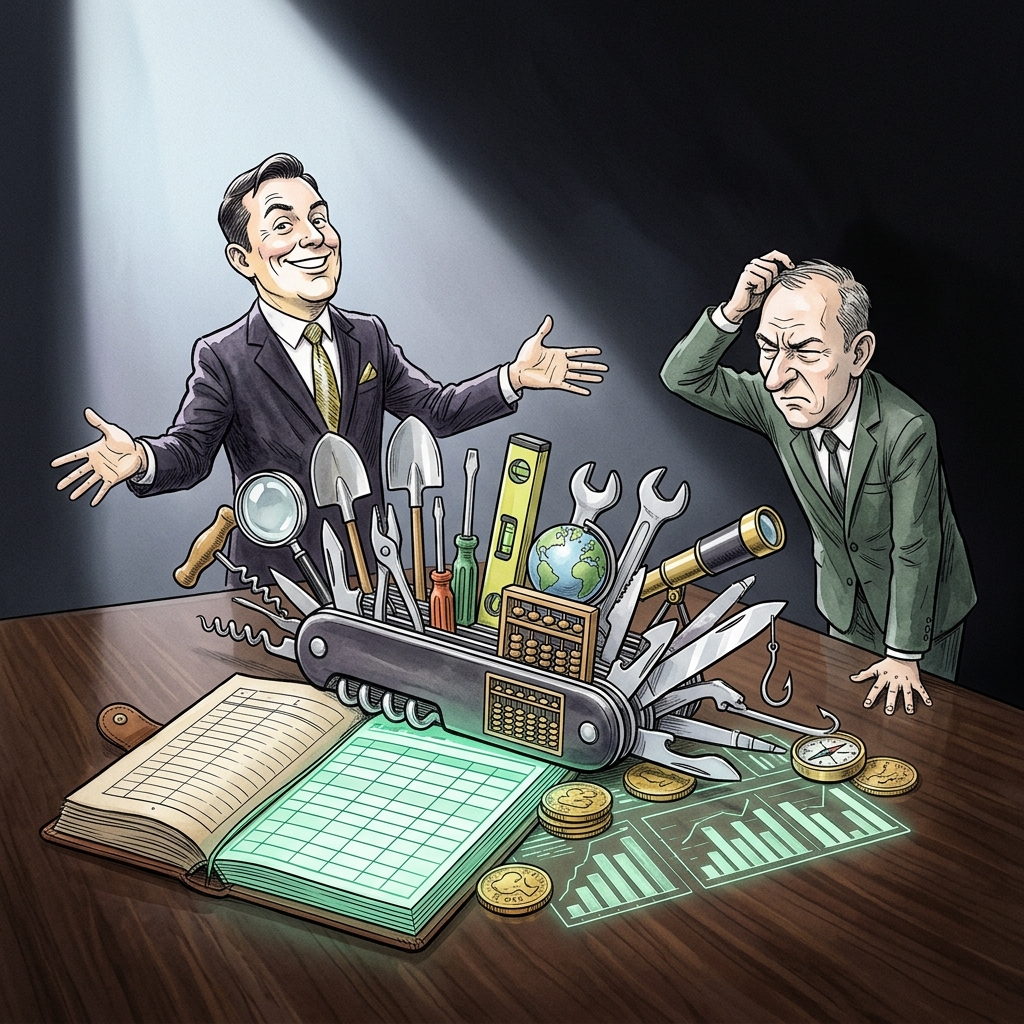
Consulting proposal win themes are short, repeated statements that link a buyer's most critical need to a discriminating feature of your offer. Three is the right number because the average procurement evaluator spends under five minutes on an executive summary, and the human brain reliably recalls three to four items from a single page. Loading a proposal with ten capabilities dilutes recall, weakens scoring, and tells the buyer you have not decided what makes you different.
Why three differentiators beat ten capabilities
The math on proposal attention is brutal. The 2025 industry benchmark from Loopio puts the average RFP win rate at 45%, up from 43% in 2024, with enterprise teams winning at 47–49% and SMBs at 42–45%. Management consulting now leads all industries in annual RFP submission volume, which means evaluators in your target buyer's procurement office are reading more proposals than ever and giving each one less time. Responsive's RFP guidance is explicit: an executive summary should be one to two pages (roughly 400–800 words) and a decision-maker will skim it in under five minutes. If you list ten capabilities, they remember none of them. If you name three discriminators tied to their hot buttons, you control the post-read conversation.
The distinction between a "capability" and a "discriminator" comes from the Shipley framework, the global standard the Association of Proposal Management Professionals (APMP) accredits training partners against. Shipley defines a discriminator as a feature that (a) differs from competitors and (b) is acknowledged by the customer as important. A "differentiator" only meets the first condition. A "capability" meets neither — it is something every credible bidder can claim. Ten capabilities is a brochure. Three discriminators is a proposal.
Actionable next step: Pull your last three proposals. Highlight every claim about your firm. If a competitor on the same shortlist could honestly write the same sentence, strike it. What survives is your real shortlist of candidate discriminators.
Consulting proposal win themes that actually score points
A Shipley-style win theme has a specific anatomy: a customer benefit, a discriminating feature, and a piece of proof. The Shipley Associates litmus test asks three questions of every theme statement: Does it state a customer benefit? Does it identify a feature unique to your offer? Does it offer substantiation a third party would believe? A theme that fails any one of the three tests is decoration, not strategy.
Compare two openings for an operational due diligence engagement aimed at a private equity buyer:
- Capability dump: "We bring deep expertise in operations, finance, technology, supply chain, talent, M&A integration, change management, analytics, ESG, and risk."
- Three-theme proposal: "(1) You will receive a 100-day integration plan by close, not 90 days after — because our deal team and integration team are the same team. (2) Your synergy case will be ranged into a low/base/high model your LPs can audit, using the same waterfall format Bain published in its 2024 M&A Report. (3) You will get a named partner on-site one week per month for the first six months, not a rotating bench."
The second version is shorter, more memorable, and harder to copy. Each theme passes the litmus test, and each is something the buyer can repeat to their investment committee without your slides in front of them. That repeatability is the whole game — the buyer becomes your internal advocate.
How to write a theme statement step by step
- Name the hot button. From the RFP, capture call notes, or discovery interviews, pull the buyer's top-stated risk or goal in their own words.
- Pair it with one discriminator. Pick the single feature of your offer the buyer has acknowledged matters and your two strongest competitors cannot match.
- Quantify the benefit. Use a number — days saved, basis points of margin, headcount avoided, weeks to first value.
- Add third-party proof. Reference a named past client, a published case, a certification, or a piece of public research.
- Repeat it. Place the same theme statement at the top of the executive summary, the top of the relevant section, and inside the cover letter — verbatim.
Actionable next step: Draft three candidate theme statements for your next live opportunity, then read each one to a colleague who was not in the pursuit. If they can repeat the gist 30 seconds later without prompting, it is a theme. If not, rewrite.
The cognitive case: why three is the magic number
Three is not a stylistic preference; it is a constraint of how busy buyers process information. According to Time magazine's analysis cited in proposal training materials, 55% of people spend fewer than 15 seconds actively reading any piece of content. Procurement panels reviewing ten proposals in a day give your executive summary about five minutes at most, according to Responsive's 2025 guidance. The Shipley method places theme statements at the top of every major section precisely because most evaluators skim headings and openers and read body text only when a theme has earned their attention.
Three themes also map cleanly to scoring sheets. Most enterprise procurement scorecards weight a handful of dimensions — typically capability fit, delivery confidence, commercial value, and risk. If you assign one theme to each of three weighted dimensions, every evaluator can find a clear hook in your proposal for the criterion they were assigned to grade. Ten capabilities scatter across the scorecard and force the evaluator to do your work for you. They will not.
A practical example: rewriting a real consulting pitch
Consider a mid-market consulting firm pitching a go-to-market redesign to a B2B SaaS company. The first draft of their executive summary listed nine "capabilities": strategy, segmentation, pricing, packaging, sales enablement, channel design, RevOps tooling, analytics, and change management. Every named competitor — Bain, BCG, Simon-Kucher, the Big Four — could claim all nine.
After applying the three-theme rule and grounding each in a piece of public proof, the same pitch read:
- Theme 1 — Revenue acceleration before tooling. "We will move your win rate three points before any new RevOps tool is implemented, because we sequence pricing and segmentation changes first. Bain's published research shows companies that address commercial performance holistically gain 3 to 5 percentage points of profit margin; we deliver the front-end of that work in 90 days, not 9 months."
- Theme 2 — A named partner, not a bench. "Your engagement partner will be on-site two days a week for the full 12 weeks. Each of our last six SaaS GTM engagements was led by the same partner who signed the proposal."
- Theme 3 — A working model your CFO can run. "Deliverables include a live Excel revenue model your finance team owns after handoff, with documented assumptions and a quarterly refresh cadence — not a deck of static charts."
Nothing was lost. The nine capabilities still appear in the staffing plan and methodology sections. But the buyer now has three memorable hooks they can defend internally.
Actionable next step: Build a reusable proposal template — an Excel template for the model, a Word template for the executive summary, and a PowerPoint shell — that forces every section to open with one of three theme statements. The template enforces the discipline.
Common failure modes (and how to fix them)
- "Themes about us, not about them." JetCo Solutions notes that the most common error in proposal coaching is themes that read like firm-history bullets. Fix: every theme must start with a buyer outcome, not a firm credential.
- Themes that change between sections. The Shipley guide is explicit that theme statements must be placed verbatim at the start of every major section. Paraphrasing dilutes recall. Fix: copy-paste the exact sentence.
- Differentiators the buyer does not value. A discriminator is only a discriminator if the buyer has said it matters. Fix: ground every theme in a direct quote from a discovery call or a phrase from the RFP.
- Too much hedging. "Up to," "as much as," and "potentially" gut a theme. Fix: replace ranges with the floor commitment ("at least three points").
- No proof. A theme without a named client, a public dataset, or a citation reads as marketing. Fix: link to a public case, a regulator filing, an investor report, or a credentialed study.
The scale context: why this matters more in 2026
The consulting market is consolidating around AI-enabled delivery. Deloitte reported $70.5 billion in global FY2025 revenue (up 4.8% year over year), and Accenture reported $69.7 billion in FY2025 (up 7%), with $1.2 billion in generative AI bookings in a single quarter. Both giants are pitching aggressively on speed-to-value and proprietary tooling. For a boutique or mid-market firm, "we have a smart team" is no longer a credible differentiator against a Big Four pitch that arrives with a working AI prototype attached. Three sharp themes — grounded in named past clients, a quantified outcome, and a piece of public proof — are the only way a smaller firm scores above its weight class on a scorecard built for the giants.
The firms that win the next decade of consulting work will be the ones that treat the proposal itself as a product: versioned, tested, and shipped with the same discipline as the engagement that follows. A pre-built proposal template with placeholders for three theme statements, a quantified executive summary, a defensible commercial model, and a buyer-specific proof section converts the most error-prone part of business development into a repeatable workflow. The win rate lift typically shows up within the first three pursuits — and unlike headcount, the template does not leave.
Sources
- Shipley Associates Blog — Do Your Theme Statements Pass the Litmus Test?
- Shipley — Discriminators and Theme Statements training
- Loopio — 38 Statistics on RFP Win Rates & Proposal Management (2025)
- Responsive — RFP Executive Summary: Example, Template, Tips
- Steerlab — RFP Win Rate Benchmarks by Industry (2025 Data)
- Bain & Company — Creating an Adaptive Go-to-Market System
- JetCo Solutions — Your Win Themes Are Not About You
- TSIA — Deloitte Competitors and Alternatives (FY2025 revenue data)
Related: Browse all Consulting Templates on ModelStack.
Get started with a free template
Download our free Unit Economics Calculator — no signup required.